



Hair Tattoo Blending with Existing Hair: Questions to Ask Hialeah and Miami Providers
Updated: 2 days ago
📌 Key Takeaways
Good SMP blending starts by separating your desired density from how the tattoo will meet your existing hair.
Separate Density From Blending: Density describes a visual effect, while blending explains how pigment meets the hair you still have.
Show Your Usual Hair: The author recommends sharing everyday photos and haircut habits so providers assess how you normally wear your hair.
Map Every Transition Area: Ask where treated areas would meet existing hair, including views from the front, side, and top.
Choose Relevant Examples: Request portfolio cases with starting points like yours, then ask what makes each example useful for your situation.
Compare Explanations Carefully: Clear providers explain assumptions, limits, and remaining questions instead of relying on photos or guarantees alone.
Clear questions reveal more than impressive photos.
Hialeah and Miami SMP clients will make better-informed consultations by using the practical blending questions and comparison checklist below.
~ ~ ~ ~ ~ ~ ~ ~ ~ ~ ~ ~ ~ ~ ~ ~ ~ ~
A convincing front-facing hairline photo can make a hair tattoo seem simple, but your design would also sit beside the hair you still have. Scalp micropigmentation (SMP), a cosmetic scalp tattoo often called a hair tattoo, is easier to plan as two questions: what density you want, and how that area would transition into your existing hair.
Whether you're meeting a provider in Hialeah or elsewhere in Miami, those two questions and the checklist below give the consultation a clear structure.
Start By Separating "Density" From "Blending"
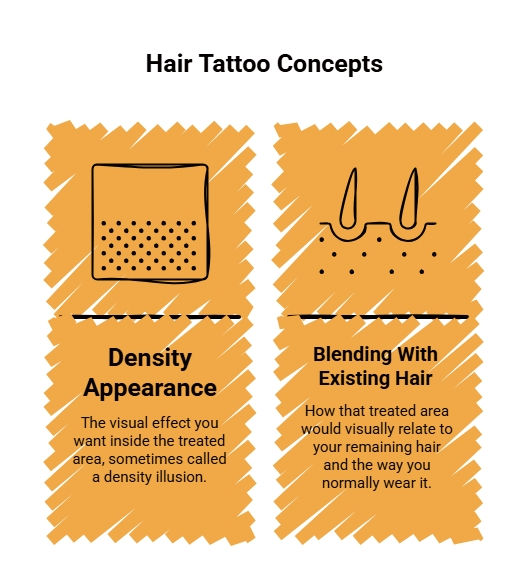
Hair tattoo density and SMP blending are easy to treat as one idea, but they answer different questions. Keeping them apart helps you describe what you want without needing technical vocabulary. Because SMP uses two-dimensional pigment to mimic three-dimensional hair, seamless blending relies entirely on matching the color and density of the tattoo to the physical hair immediately surrounding it.
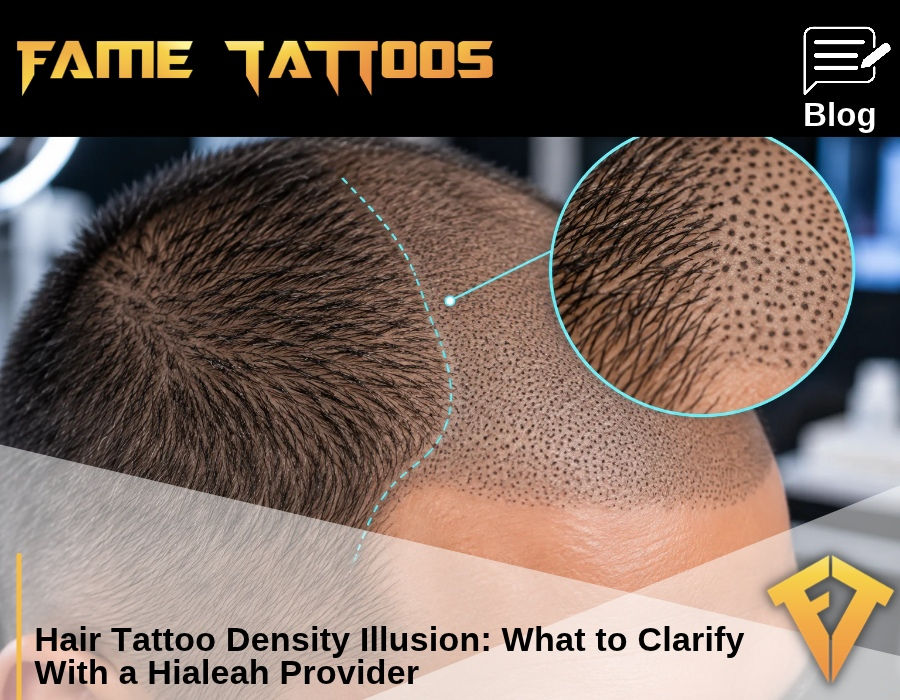
Density Appearance: the visual effect you want inside the treated area, sometimes called a density illusion.
Blending With Existing Hair: how that treated area would visually relate to your remaining hair and the way you normally wear it.
Neither term describes a promised result. Both are topics for the provider to explain for your hair specifically.
Density, in this conversation, describes appearance only. It is not hair growing back, strands becoming physically thicker, or texture changing. If an explanation starts to sound like hair restoration, ask the provider to restate it in purely visual terms.
It's tempting to ask, "Will it look natural?" That question folds both topics together and tends to invite reassurance instead of specifics. If a provider opens with "What look do you want?", you can answer in two parts: the density you're picturing, and where you expect it to meet your existing hair. You can also turn the question around and ask, "Which part of the plan concerns the transition into my existing hair?"
Show The Provider How You Normally Wear Your Hair
Describe how you usually wear your hair, not just how it looks on consultation day. A provider sees your hair on one day, at one length, and that snapshot may not match the rest of your month. Talking about hair loss can feel uncomfortable, but this part of the conversation doesn't require dwelling on it. It centers on your usual hairstyle.
Describe what a single visit can't reveal:
Your usual haircut and the length you keep between cuts
How often you cut it, and whether that schedule changes
Where you part it and how you style it on an ordinary day
The presentation you expect to keep long term, not just today's
Ordinary photos can fill in the rest of the month. Useful shots include your hair right after a cut, between cuts, parted a different way, or styled as you wear it on a typical day.
For example, if you maintain a close cut for part of the month but let the top grow longer between visits, do not assume the provider's plan accounts for whichever length you happen to have on consultation day. A reasonable follow-up is, "Would you need to see my hair at my other usual length?"
How scalp micropigmentation and hair length interact is a technical judgment for the practitioner, and a general article can't answer it for your hair. If you change styles often, say so early. A useful follow-up question is, "Which hairstyle assumptions are built into your explanation?" The point isn't to pick a haircut because an article recommends one. The point is to make sure the provider understands how you expect to wear your existing hair.
Ask The Provider To Identify Every Transition Area
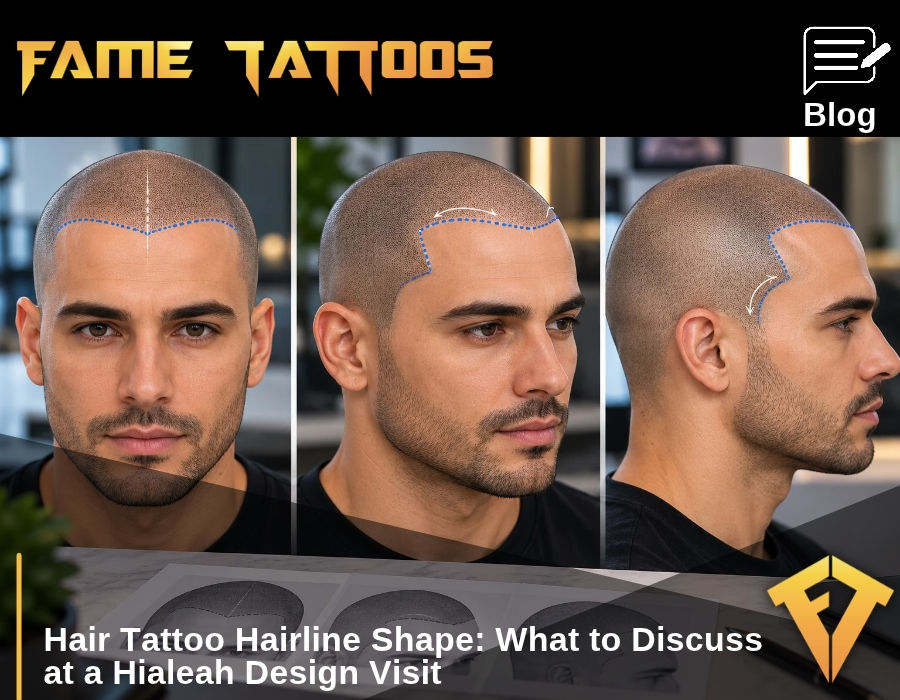
A transition area is any place where the proposed pigmented area would end or visually meet your existing hair. A suggestion to "just match the pigment to your hair" doesn't identify those places, so ask the provider to name them. Depending on your existing hair and presentation, SMP transition areas may include:
The front hairline
The temples
The sides
The top
The crown
The back
Not every area will apply to you, and your situation may involve one not listed here. Treat the list as prompts for the consultation rather than instructions about where pigment should go, and let the provider explain which areas apply and why. Start with "Where would the treated area end?" and then ask, "Can you show me the plan from the front, side, and top?"
Those angles matter because daily life isn't a front-facing photo. A coworker sees you in profile across a desk, someone standing while you sit sees the top of your head, and your bathroom mirror mostly shows the front. Ask which boundaries are hard to judge from the photos you've shared and which can only be assessed in person.
If you're comparing nearby providers, this is a useful point of comparison: can each one name the same areas clearly and explain the reasoning in plain language? An answer that covers only the hairline has addressed part of the question.
Request Examples That Match Your Starting Point, Not Just Your Preferred Finish
Liking a portfolio and finding it relevant are separate questions. A comparable reference example is one where the person's starting point resembles yours closely enough to say something about your own plan. The example is useful only if the provider can explain why it is relevant to your starting point.
When you review SMP provider examples, ask about:
Starting point: whether the person's hair pattern or presentation resembled yours
Transition areas: whether the images show the boundaries that matter for your hair
Angles: whether more than one useful view is available
Timing and context: when the images were taken and what else the provider can share about them
Differences: what separates the example from your own starting point, and why that matters
An example photo showing a sharp front hairline—but omitting the temples, sides, crown, or top—answers a hairline question, not a blending question. This omission doesn't prove anything negative about the provider, but it does mean you must ask if other angles are available. Ask whether other views exist.
Sometimes a provider won't have an example close to your starting point, and that absence says nothing definitive about skill either way. Ask what differs between the nearest example and your hair, and which differences can only be judged in person. None of this requires you to grade technical skill from a photograph. You're only checking whether an example helps answer your question.
If Fame Tattoos is on your list, you can review its scalp micropigmentation services page with these questions in mind. Treat a provider's own service page as information about that provider, not as independent proof of any particular result.
Use This Hair Tattoo Blending Consultation Checklist
Screenshot or print these hair tattoo consultation questions so you have them in front of you. The table won't predict your result, but it makes vague answers easier to spot.
Ask This | What the Question Clarifies | Follow-Up to Request |
What does "density" mean in the design you're proposing? | Whether the goal is described as a visual effect, not physical hair change | A plain-language description of the visible change in the treated area |
Which areas need to transition into my existing hair? | Whether the plan extends beyond the front hairline | A named list of the boundaries that apply to your head |
Which hair length and style are you assessing? | What presentation the plan assumes | Confirmation that it matches how you usually wear your hair |
What would need reassessment if I change my length or style? | How much the plan depends on one presentation | The specific changes that would call for another conversation |
Can you show examples with a starting point like mine? | Whether the evidence is relevant to you | An explanation of what makes each example comparable |
Can you show front, side, and top views? | Whether transition areas are visible in the evidence | Views that match how others see you day to day |
What can and can't you judge from photos? | The limits of remote evaluation | A clear line between photo-based comments and open questions, plus what additional information would help |
What must be evaluated in person? | What stays unknown until an assessment | The items an in-person assessment would cover |
What limitations should I understand before deciding? | Whether the provider discusses uncertainty | Limitations stated plainly, without guarantees |
How will you document or explain the visual plan before the service? | Whether you'll leave with something concrete to review | A written or visual summary you can look over before committing |
Apart from visual blending, ask the studio to explain its actual safety protocol. Fame Tattoos states that it uses "100% disposable, single-use sterile equipment." That statement describes the studio's stated practice and isn't a guarantee that all risk is eliminated.
Compare The Explanation, Not Only The Photograph
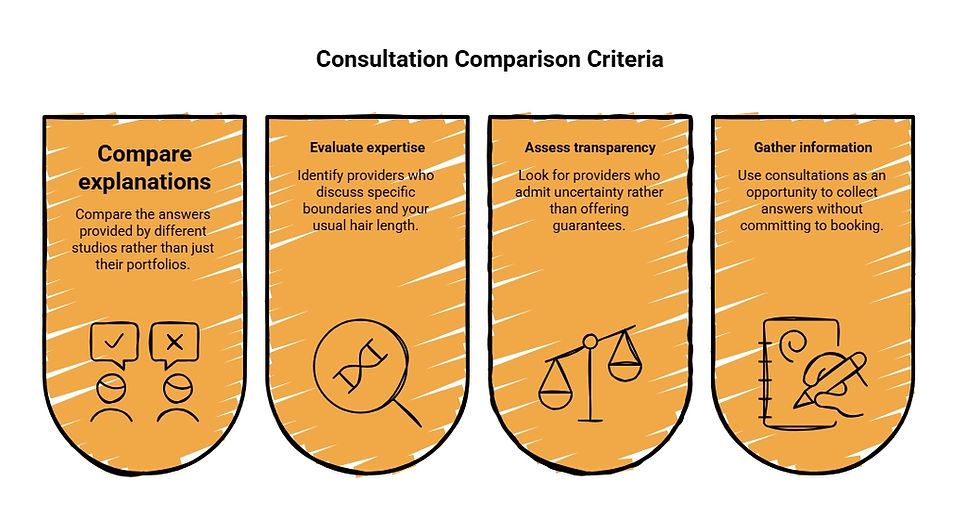
After you've asked more than one provider the same questions, compare the answers rather than the portfolios. A strong explanation addresses your actual hair presentation, names the areas under discussion, says why an example is or isn't relevant, and marks what still needs an in-person look. It also admits uncertainty, because a guarantee about how your design will blend offers confidence, not evidence.
Taking this checklist to multiple studios will quickly highlight differences in expertise. A provider who only discusses the hairline and offers vague reassurance about the crown is less helpful than one who identifies your specific boundaries, details what must be judged at your usual length, and clearly contrasts their portfolio examples with your actual hair. The latter conversation gives you far more concrete information to base a decision on.
Superlatives in local search results and a city's prestige don't answer any of these questions. You also don't need to score or rank anyone. Asking questions doesn't commit you to booking, so each consultation can simply be a chance to gather answers.
Your Next Step Before Any Consultation
The essentials are simple: define the density goal, identify the transition areas, and request examples relevant to your starting point. Bring this checklist to a provider discussion and ask the provider to explain how the proposed design would transition into your existing hair.
Prepare these questions and use them with any Hialeah or Miami provider you are evaluating. Results and suitability vary, and no general article can predict an individual result, so the answers come from an individualized assessment. If you're considering Fame Tattoos in Hialeah, use the Hair Micropigmentation Request Form to submit your blending questions to Fame Tattoos.
Frequently Asked Questions
Is density illusion the same as making my hair physically thicker?
No. "Density illusion" describes a visual goal and doesn't mean your hair will grow, thicken, or change texture. If you have a scalp condition or questions about the cause of your hair loss, raise them with a licensed healthcare professional.
Can a hair tattoo blend with longer existing hair?
There's no universal answer, because this may depend on your usual hair presentation. Ask the provider to assess the length you actually maintain and to name the assumptions the proposed design would rely on.
What portfolio photos should I ask an SMP provider to show?
Ask for examples whose starting point resembles your remaining hair, with the transition areas you care about visible from more than one angle. Also ask when each image was taken and what context the provider can share about it.
What should I bring to a local SMP consultation?
Bring a few everyday photos that show your hair from the side and top at the lengths you actually wear, since a single front-facing selfie may not show that. Add a note on how often you cut your hair, plus the checklist above.
Should I choose a Hialeah or Miami provider based mainly on location?
Location can make appointments more convenient, but it doesn't show whether a provider's examples or explanations fit your needs. Use the same questions with each provider, and weigh distance only after you've compared the answers.
Disclaimer: This article provides general educational information about questions to discuss with a scalp-micropigmentation provider. It is not medical advice, does not determine whether the service is appropriate for you, and cannot predict an individual result. A qualified practitioner should assess your scalp, existing hair, goals, and relevant health history in person.
Editorial Process
The Fame Tattoos Insights Team creates educational body art resources based on client questions, studio experience, safety-first standards, and professional research. AI tools may support organization and drafting, but final content should be reviewed, rewritten, and fact-checked by qualified human editors before publication.
About the Fame Tattoos Insights Team
The Fame Tattoos Editorial Team creates clear, safety-conscious body art guides based on studio experience, client questions, and professional aftercare standards. Every guide is reviewed for accuracy, clarity, and practical usefulness before publication.

.jpg)
.jpg)

.jpg)
.jpg)

.jpg)
.jpg)
.jpg)
.jpg)