



Soft or Defined Hair Tattoo Edges? Questions to Ask a Hialeah or Miami Provider
📌 Key Takeaways
The author recommends separating edge definition from placement and contour so you can describe the hairline you actually want.
Separate The Design Choices: Placement sets height, contour sets shape, and edge definition controls how clearly the front border appears.
Compare Real Examples: Ask providers to show similar hairline shapes with different edge strengths, including front and side views.
Use Focused Reference Images: Bring two or three clear photos and explain the specific feature each image represents.
Choose Clear Words: Terms like “natural” can mean different things, so confirm how each provider describes soft and defined edges.
Check Safety Separately: The author recommends confirming current Florida licenses and asking about sterile, single-use needles before choosing a provider.
Clear words make hairline preferences easier to discuss.
Hialeah and Miami-area SMP clients will communicate their hairline preferences more clearly using the questions and reference-image guidance below.
~ ~ ~ ~ ~ ~ ~ ~ ~ ~ ~ ~ ~ ~ ~ ~ ~ ~
You look at a provider's photo and think, "I like the idea, but the front looks too outlined for me." That reaction is useful even before you can describe the alternative. It usually points to edge definition—how gradually or clearly a hairline's front border reads. Edge definition is a separate decision from placement and contour, which set where the hairline sits and the path it follows. "Natural" rarely closes the gap, because it can mean several different things at once.
Cleveland Clinic describes scalp micropigmentation (SMP), also called a hair tattoo, as a cosmetic treatment that deposits small dots of pigment on the scalp to create a hairlike appearance.
This guide is for Hialeah and Miami-area readers preparing for a design conversation. The questions, reference-image method, and preference worksheet below turn that first reaction into clear words. None of it determines whether SMP is appropriate for you.
First, Separate Hairline Placement From Edge Definition

Three terms carry most of a design discussion:
Placement is where the proposed hairline sits across your forehead and temples.
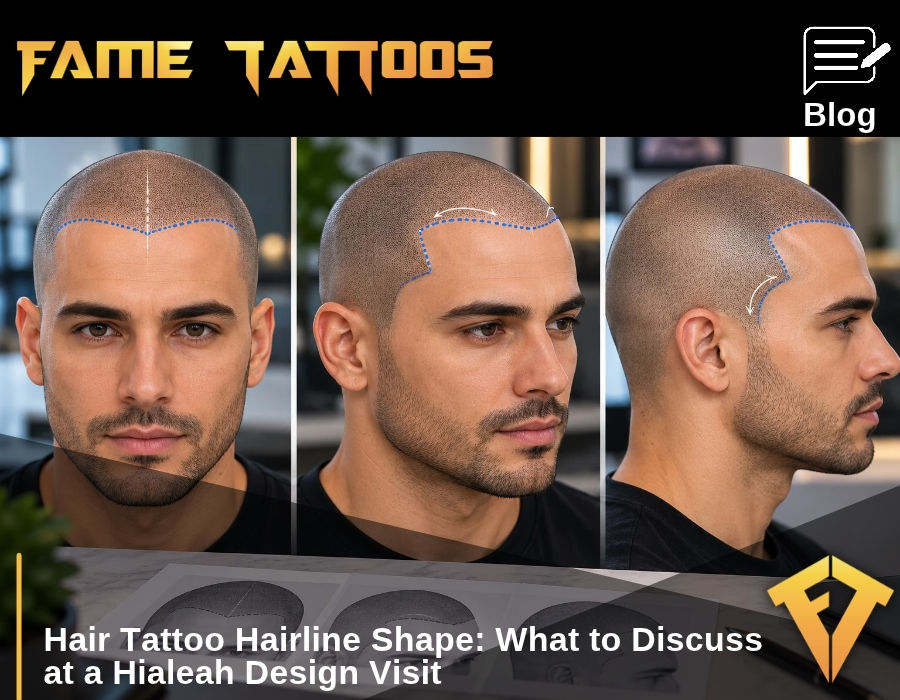
Contour is the overall route the hairline follows: straighter, more rounded, softened at the corners, or something else.
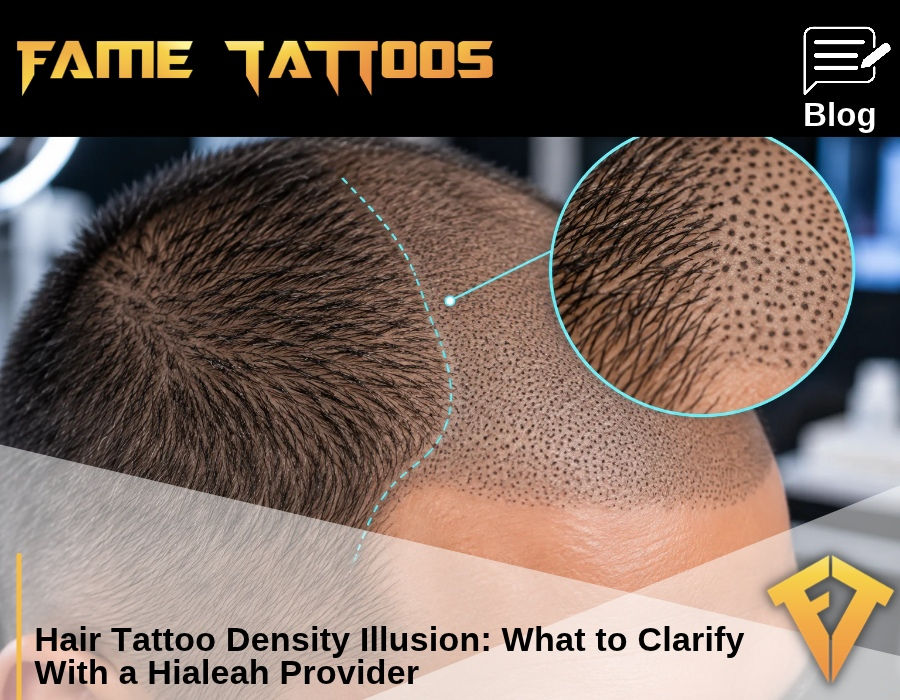
Edge definition is how the front boundary is perceived, from a gradual transition to a clear, continuous border.
Placement and contour describe shape, while edge definition describes the border itself. Keeping them apart matters because a single photograph contains all three at once. If you say "I want this hairline," a provider may not know whether you mean its height, its overall route, its front border, or its side transition.
Picture a hypothetical pair of examples, A and B, that follow nearly the same route across the forehead. Example A seems to transition gradually at the front. Example B shows a clearer, more continuous boundary.
Neither version is correct; each communicates a different preference. The reverse also happens, with similar edges at different heights. Once you see this split, any hair tattoo portfolio becomes easier to read. You can ask yourself which feature you're reacting to, then tell the provider directly: "I like this contour, but I want to discuss a different edge finish."
Softer And More Defined Edges Belong On A Spectrum
A soft edge is a front border that appears less continuous, less abrupt, or more gradually transitioned. A defined edge is one that appears clearer and more visibly bounded. These are the two ends of a range, and many preferences fall somewhere between them. Keep in mind that all SMP pigment softens slightly over time. A moderately defined edge today may naturally heal into a softer transition within a few years.
Edge appearance | What to look for | Useful question | Wording that can mislead |
Softer | The front seems to blend rather than stop | "Which of your examples shows your softest front edge?" | "Invisible" |
In between | A recognizable boundary with some gradual transition | "Can the edge fall between these two examples?" | "Normal" |
More defined | A clear, continuous front line | "How do you describe a more defined edge in your own work?" | "Fake" or "harsh" |
"Soft" does not automatically mean vague, and "defined" does not automatically mean artificial; each is a legitimate preference. Providers don't all use these terms the same way, so ask each one to explain their vocabulary by pointing to their own examples.
The distinction also appears in technical writing. A small 2025 case series of ten patients noted that technical refinements in needle selection, pigment layering, and depth control help optimize outcomes, while practitioners commonly avoid visually uniform transitions using randomized pigment distribution and gradual density reduction near hairline edges.
Hairline Edge Preference Worksheet
Fill this in before a design discussion and bring it with you. Each row isolates one decision.
Decision to clarify | What to note | Question to ask |
Edge strength | Softer, moderately defined, clearly defined, or uncertain | "Which of your examples is closest to this level of edge definition?" |
Overall placement | Whether an image matters for placement or only for the edge | "Can we discuss placement separately from edge softness?" |
Contour | Whether you like the overall route of the hairline | "Is this contour separate from the border treatment?" |
Front transition | How the border should look from straight ahead | "Can you show a comparable front view?" |
Side transition | How the edge should continue toward each side | "Can I see the left and right transitions?" |
Reference purpose | The single feature each image communicates | "Which part of this image is useful for my request?" |
Image context | Whether timing, lighting, or angle is known | "What context is available for this photograph?" |
Shared wording | Your final plain-language description | "Can you summarize the edge preference we have agreed on?" |
Your notes can then become one opening sentence: "I like the general placement and contour in this example, but I want the front edge to appear [softer / moderately defined / more clearly defined], especially when viewed from [the front / the sides / both]."
Questions To Ask About Hairline Edge Definition
These questions work whether you're speaking with a provider in Hialeah or comparing examples from the broader Miami area. A design discussion works as a collaboration: you describe what you see, and the provider explains what their examples show. Detailed questions don't signal distrust, and the provider doesn't have to decide everything alone.
Separate the decisions. This group keeps the hairline's shape and its border from blurring into one request.
"Can we discuss the hairline's placement and contour separately from the edge finish?"
"How do you define a soft edge in your own examples?"
"How do you describe a more defined edge?"
Compare the right examples. Side-by-side images turn an abstract word into something you can point at, and front and side views can reveal different parts of the same hairline.
"Can you show two examples with a similar general shape but different edge definition?"
"Can the edge fall between the examples you are showing me?"
"Can I see front, left-side, and right-side views where available?"
Test your references. These questions stop one photograph from quietly standing in for an entire design.
"Which part of my reference image is relevant to my request?"
"Which parts of this image may not apply to me?"
"When was this portfolio image taken, if that information is available?"
"What should I avoid assuming from these photographs?"
Confirm before deciding. A restatement catches misunderstandings while they are still easy to correct.
"Can you summarize the edge preference we discussed before I make a decision?"
"Can I take time to review the proposed appearance before proceeding?"
Here's how the last group might sound in a hypothetical exchange. You say, "I like the general shape, but I want less visible definition at the front." The provider points to two relevant examples and explains how their edges differ. You reply, "So we are discussing the same placement, with an edge between these two examples. Is that correct?"
Keep The Appearance Discussion Separate From The Basic Safety Check
Appearance is only one part of choosing a provider. The Florida Department of Health classifies micropigmentation within tattooing, so you can verify that both the artist and the establishment hold current licenses. Its consumer guidance also lists sterile, single-use needles among the checks worth making.
Fame Tattoos states that it uses 100% disposable, single-use sterile equipment. These checks matter, but none of them guarantees safety or a particular appearance. Learn more about Fame Tattoos' hair-micropigmentation service.
Choose Reference Images That Show The Specific Feature You Want To Discuss
A reference image is a photo you bring to show a visual preference, not a design to be copied. Two or three focused images usually say more than a large gallery of conflicting details. Before any appointment, note what each one is for: edge softness, clearer definition, placement, contour, or the side transition.
Say you find a hypothetical photo whose front border looks as gradual as you'd like, but whose hairline sits higher than you want. Your note might read, "I like how gradually the front border appears in this photograph, but I am not using it as a reference for the height or overall contour." When you show it, one sentence carries the point:
"I am showing this image for the edge finish, not for the hairline height or overall contour."
Treat lighting, angle, camera distance, hair length, and image timing as context rather than proof of quality. Each of these can change how a border appears in a photograph. A reference shows a preference, not a promise that your result would look the same. Ask the provider which aspects of each image are relevant and which are not, instead of asking them to reproduce another person's entire design.
Reference-Image Check
The edge is clearly visible.
The angle is useful.
The image is clear enough to discuss.
You can name the specific feature you like or dislike.
You're treating the image as a reference, not an exact-result request.
Evaluate the explanation, not just the photograph
By the end of a productive design discussion, the conversation should have:
distinguished shape from edge,
explained terminology in plain language,
compared examples relevant to your concern,
acknowledged the limits of applying a photograph to you, and
left you able to restate your preference.
Test that last point after the discussion: "I prefer this general placement and contour, but I want the border to appear [softer / more defined / between these examples] from the front and sides." If you can't complete that sentence confidently, ask one more question before moving forward.
A provider who identifies why your reference may not transfer directly can be more useful than one who offers a broad promise. Even so, a clear explanation is one factor in your decision. It doesn't independently prove technical skill, predict your outcome, or determine whether SMP is medically suitable for you.
Common Mistakes When Describing A Hairline Edge

Each of these mistakes leaves room for you and the provider to picture different hairlines. None of them makes you a difficult client.
Saying only "make it natural" without naming what natural looks like to you
Treating placement, contour, and edge definition as one decision
Bringing a photograph without explaining its purpose
Comparing images from very different views, or looking only at the front
Treating soft and defined as good and bad
Asking for an exact copy, or treating a portfolio as a guarantee
Assuming every provider uses the same terminology
Letting the provider decide everything, or agreeing to wording you can't restate
FAQs
Is a softer hair tattoo edge always more natural-looking?
No universal answer exists. "Natural-looking" is subjective and depends on the overall design, your goals, your surrounding appearance, and how the provider interprets your request. Comparing specific examples will tell you more than relying on the word "natural."
Can I ask for an edge between soft and highly defined?
Yes. You can ask whether the provider can discuss an intermediate appearance and show relevant examples. Providers don't all offer or describe the same range in the same way, so confirm what "in between" means to the person you're speaking with.
What reference photographs should I bring?
Bring two or three clear images that show the specific edge feature you like or dislike. Include front and side views where possible. Note whether each photo is meant to show edge definition, placement, contour, or side transition.
What should I ask about portfolio photographs?
Ask what the photograph is meant to demonstrate, whether other views are available, and when it was taken if that information exists. Also ask which details make it relevant to your request. Treat the portfolio as examples of that provider's work, not a prediction of an identical outcome.
Arrive With Examples, But Leave With Clear Words
The edge that bothered you in that first photo now has a name, and it may have nothing to do with placement or contour. Picture a hypothetical reader comparing a local studio with another Miami-area provider. Instead of asking which provider is "best," they ask each one to explain the same edge preference using comparable front and side views. Then they check whether they can restate the answer.
Fame Tattoos is located in Hialeah, so if you're elsewhere in the area, confirm availability when you reach out. When you're ready, choose two or three reference images and note which edge feature each one demonstrates. Then request a hair-micropigmentation consultation to start a design conversation with Fame Tattoos.
Disclaimer: This article provides general educational information about hairline design discussions. It is not medical advice and does not determine whether scalp micropigmentation is appropriate for you. Verify current Florida artist and establishment licenses, and discuss your individual goals, health history, skin, hair loss, potential risks, and expected results with appropriately qualified professionals.
Editorial Process
The Fame Tattoos Insights Team creates educational body art resources based on client questions, studio experience, safety-first standards, and professional research. AI tools may support organization and drafting, but final content should be reviewed, rewritten, and fact-checked by qualified human editors before publication.
About the Fame Tattoos Insights Team
The Fame Tattoos Editorial Team creates clear, safety-conscious body art guides based on studio experience, client questions, and professional aftercare standards. Every guide is reviewed for accuracy, clarity, and practical usefulness before publication.

.jpg)
.jpg)

.jpg)
.jpg)

.jpg)
.jpg)
.jpg)
.jpg)