



The Nickel-Free Promise: What to Ask Your Piercer Before the Needle Comes Out
📌 Key Takeaways
A safe piercing starts before the needle, with clear answers about jewelry, equipment, fit, and aftercare.
Ask Before Piercing: Three clear questions can reveal whether a piercer respects your safety and comfort.
Verify Jewelry Material: Nickel-aware clients need exact metal details, not vague promises like “don’t worry.”
Choose Single-Use Supplies: Sterile, one-time-use supplies help reduce the risk of germs moving between clients.
Fit Comes First: Fresh piercings need jewelry that fits your anatomy, swelling, and healing stage.
Pause On Pressure: Rushed, vague, or annoyed answers are signs to slow down before getting pierced.
Clear answers now can prevent stress, irritation, and regret later.
People with sensitive skin or piercing nerves will feel more prepared, guiding them into the safety-specific details that follow.
~ ~ ~ ~ ~ ~ ~ ~ ~ ~ ~ ~ ~ ~ ~ ~ ~ ~
Ask before the needle.
The phone is in your hand, the front desk is waiting, and your stomach tightens for a second. What if this jewelry irritates my skin? What if they rush me? What if the right question sounds awkward?
You only need three questions. A professional piercer should be comfortable answering them before anything touches your skin. If the answer is clear, patient, and specific, that is a green flag. If the answer is vague, rushed, or dismissive, you are allowed to pause.
A safe piercing starts with more than good placement. It starts with verified jewelry, single-use sterile equipment, and a piercer who explains the process without making you feel difficult.
Ask These Questions Before the Needle Comes Out
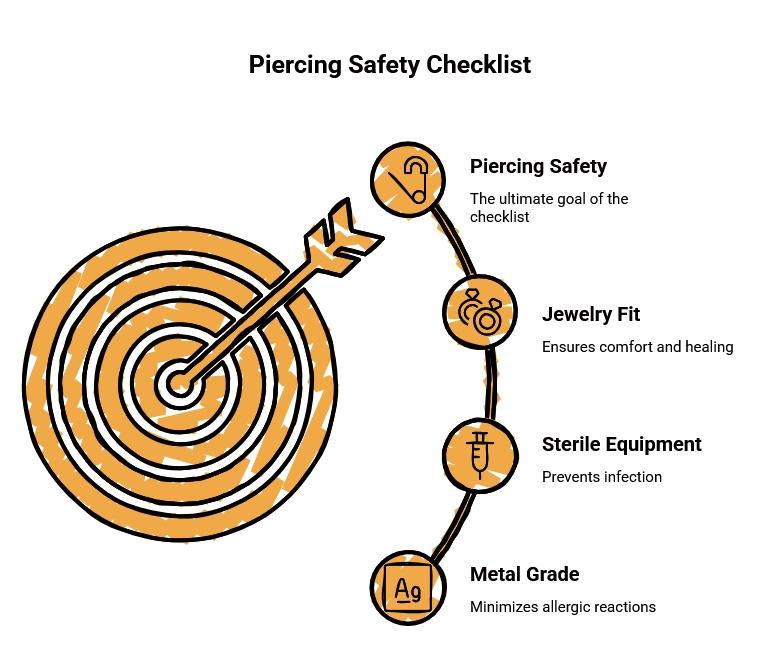
Before any piercing, ask these three questions:
What exact metal grade will you use for my initial jewelry?
Will the equipment that touches my skin be single-use, sterile, and opened for my appointment?
How will you choose the right size and fit for my anatomy and healing stage?
That is the whole script. It works whether you are calling ahead, standing at the front desk, or already sitting in the chair.
The goal is not to interrogate your piercer. The goal is to protect your skin, your comfort, and the final look of the piercing. A curated piercing starts with the right material, one-time-use supplies, and jewelry that fits your anatomy. Not just the piece that looks cute in the case.
Question 1 — “What Exact Metal Grade Will You Use for My Initial Jewelry?”
Start with the material question.
The phrase to listen for is mill-certified implant-grade titanium. You can also ask whether the jewelry meets ASTM F-136 or another recognized implant-grade standard. ASTM F-136 refers to a titanium alloy specification used for surgical implant applications; it is more specific than simply saying “titanium.” The ASTM F136 standard describes chemical, mechanical, and metallurgical requirements for wrought titanium-6aluminum-4vanadium ELI alloy used in surgical implants. (ASTM International)
A good answer sounds specific:
“We use implant-grade titanium that meets a recognized standard, and we can explain our jewelry source.”
A weak answer sounds vague:
“It’s fine.”“Everyone uses this.”“It’s hypoallergenic, don’t worry.”
That does not mean every mention of surgical steel is automatically a deal-breaker. Some studios use surgical steel, and material policies vary. The issue is transparency. If you have sensitive skin or a known nickel concern, “don’t worry” is not enough information.
The American Academy of Dermatology identifies nickel as one common cause of allergic contact dermatitis and recommends avoiding nickel exposure if you have a nickel allergy. (American Academy of Dermatology) That does not mean every piercing bump is a nickel reaction. It means nickel-aware clients have a valid reason to ask clear material questions before the piercing begins.
The best time to ask about metal grade is before there is a bump, itch, or burning feeling to troubleshoot.
Why Safe Jewelry Can Still Look Good
Safe jewelry is not boring. It is the foundation of the look.
Minimalist jewelry looks cleaner when the surrounding skin is calm. A tiny nostril stud, a neat hoop after healing, or a simple curated ear stack depends on more than shine. It depends on comfort, proportion, and skin that is not fighting the jewelry.
Think of it like a shoe. The wrong shoe can rub even if the material is beautiful. Piercing jewelry works the same way: the right material still needs the right fit.
Question 2 — “Will the Equipment Be Single-Use, Sterile, and Opened for My Appointment?”
The second question is about what touches your skin.
Ask:
“Will the equipment that touches my skin be single-use, sterile, and opened for my appointment?”
This question keeps the safety conversation simple. You are not asking for a technical lecture. You are asking whether the supplies used for your piercing are sterile, disposable, and used one time only.
At Fame Tattoos, our safety position is direct: strictly single-use sterile needles paired with professionally autoclaved instruments. That means every needle is used exactly once and discarded, while our professional tools undergo hospital-grade sterilization before ever touching the next client.
This matters because disposable equipment removes the cross-contamination risk associated with reused tools. It also removes the uncertainty that comes from wondering whether a reusable item was cleaned correctly, handled correctly, or prepared correctly after the last appointment.
A green flag answer sounds like this:
“Yes. The equipment that touches your skin is sterile, single-use, and opened for your appointment.”
A red flag answer sounds like this:
“Don’t worry about it.”“We already handled that.”“Just sit down.”
You are allowed to ask for clarity. A professional should be able to explain the safety process in plain English before the piercing starts.
If you are comparing a piercing shop in Miami, look for language and behavior that make safety visible. Calm explanation matters. So does patient pacing, single-use sterile equipment, and aftercare guidance that makes sense before you leave.
Question 3 — “How Will You Choose the Right Size and Fit for My Anatomy?”
Material matters. Equipment safety matters. Fit matters too.
Ask:
“How will you choose the right size and fit for my anatomy and healing stage?”
A good piercer should be able to explain why a stud, post length, gauge, or future hoop size works for your anatomy. A fresh piercing needs room for normal healing changes. Jewelry that pinches, gaps, rotates, or presses can irritate the healing channel even when the metal itself is appropriate.
This is where trend pressure can get sneaky. You may want the tiny hoop you saw online. That does not mean it is the right first piece for your nose, ear, or healing stage.
A good studio will explain the path. You may start with jewelry that supports healing, then move into a different look after the piercing is ready. If you want more detail on why popular nose rings might not fit every face, read popular nose rings might not fit your face.
Green Flags vs. Red Flags in a Piercer’s Answer
Ask About | Green Flag | Red Flag |
Metal grade | The piercer names a specific material standard or grade. | The piercer gives vague reassurance only. |
Nickel risk | The piercer understands why sensitive-skin clients ask. | The piercer acts annoyed or dismissive. |
Single-use equipment | The piercer confirms sterile disposable equipment is used once. | The piercer avoids explaining what touches your skin. |
Fit | The piercer discusses anatomy, swelling, and healing stage. | The piercer only asks what looks cute. |
Consent | The piercer pauses and answers before starting. | The piercer rushes toward the needle. |
A vague answer is enough reason to pause. You do not have to apologize for protecting your face.
For a closer look at what should be visible in a professional setup, read what you should see before you sit down. If your concern is irritation, review the difference between piercing bumps and cheap jewelry before assuming every bump means the same thing.
What to Do If the Answer Feels Rushed or Vague
You can ask one follow-up question.
Try this:
“I have sensitive skin, so I need to be careful about material and safety. Can you tell me the exact jewelry grade and confirm the equipment is single-use?”
That sentence is calm. It is also clear. It gives the piercer a chance to answer properly without turning the moment into a confrontation.
If the answer still feels rushed, you can decide not to get pierced that day. A good studio will not shame you for asking. A professional should understand that body jewelry is not just decoration. It is something that will sit inside healing tissue.
“Your health and safety are worth walking away from a studio that cannot verify its jewelry materials or explain what touches your skin.”
That is not dramatic. It is practical.
Studio Vetting Script: Save These 3 Questions to Your Phone
1. What exact metal grade will you use for my initial jewelry?
2. Will the equipment that touches my skin be single-use, sterile, and opened for my appointment?
3. How will you choose the right size and fit for my anatomy and healing stage?
If the answer is clear, patient, and specific, that is a green flag. If the answer is vague, rushed, or dismissive, pause before moving forward.
For calling ahead, use this front desk version:
“Hi, I have sensitive skin. What exact jewelry material do you use for initial nose piercings?”
“Is the equipment that touches the skin single-use and sterile?”
“Do you help choose jewelry based on anatomy and healing stage?”
Save the script before your piercing appointment. It is easier to ask when the words are already in front of you.
After You Choose a Studio, Keep the Safety Mindset Going

Good choices do not stop after the jewelry is placed.
Follow the studio’s aftercare instructions. Avoid unnecessary touching. Do not treat irritation with random internet remedies, and do not put antibiotic cream, ointment, petroleum products, or isopropyl alcohol on a piercing unless a qualified professional specifically tells you to.
Fame Tattoos’ piercing aftercare guidance says not to submerge piercings in pools, hot tubs, saunas, saltwater, or steam for a minimum of 60 days. It also advises against shaving over the piercing for at least 30 days and avoiding excessive sweating for at least 1 week.
If you are in Hialeah or the greater Miami area and want to talk through material, fit, single-use sterile equipment, and aftercare before deciding, you can contact Fame Tattoos or review the piercing information before your visit.
A beautiful piercing is not only about jewelry. It is about calm skin, clear answers, and a piercer who respects the question before the needle.
Frequently Asked Questions
What should I ask before getting a nose piercing?
Ask what exact metal grade will be used, whether the equipment that touches your skin is single-use and sterile, and how the piercer chooses the right size and fit for your anatomy and healing stage.
What does nickel-free jewelry mean?
Nickel-free jewelry is chosen with nickel exposure as a primary concern. If you have a nickel allergy, avoiding nickel-containing items is generally recommended by dermatology authorities. (American Academy of Dermatology)
Is ASTM F-136 titanium the same as regular titanium?
No. ASTM F-136 refers to a specific titanium alloy standard used for surgical implant applications. It is more specific than simply saying “titanium.” (ASTM International)
Why does single-use equipment matter?
Single-use equipment is used once and discarded. That removes the cross-contamination risk connected to equipment being used on more than one client.
What if my piercer gets annoyed when I ask?
That is a red flag. A reputable piercer should be willing to explain material, single-use sterile equipment, and fit before the procedure starts.
Disclaimer: This article is for general educational purposes only and is not medical advice. If you notice signs of infection, severe swelling, spreading redness, fever, unusual discharge, or a suspected allergic reaction, contact a licensed medical professional.
Our Editorial Process:
Our expert team uses AI tools to help organize and structure our initial drafts. Every piece is then extensively rewritten, fact-checked, and enriched with first-hand insights and experiences by expert humans on our Insights Team to ensure accuracy and clarity.
By: Fame Tattoos Editorial Team
The Fame Tattoos Editorial Team creates educational resources on tattoos, piercings, aftercare, and body-art safety for clients in Hialeah and the greater Miami area.


.jpg)
.jpg)

.jpg)
.jpg)

.jpg)
.jpg)
.jpg)
.jpg)