



What to Bring to a Nose Piercing Appointment on a Hot Day in Hialeah
📌 Key Takeaways
Hot-day nose piercing preparation works best when you pack basics, check heat alerts, and follow your piercer’s instructions.
Pack Only Essentials: Bring water, your phone, valid photo ID, and only the items your studio specifically requests.
Check Heat Alerts: The CDC and National Weather Service recommend fluids, less outdoor exposure, shade, and cooled spaces during significant heat.
Simplify Your Schedule: Reduce unnecessary outdoor stops and ask your piercer about swimming, workouts, heavy sweating, or face contact.
Show Required Face Gear: The author recommends showing glasses or protective equipment to your piercer before deciding the piercing’s placement.
Get Direct Aftercare: Follow your piercer’s current instructions, and ask a licensed healthcare professional about symptoms or medical concerns.
Bring less, confirm more, and plan for heat.
Hialeah piercing clients will plan a cooler, simpler visit using the packing, travel, and aftercare guidance below.
~ ~ ~ ~ ~ ~ ~ ~ ~ ~ ~ ~ ~ ~ ~ ~ ~ ~
A nose-piercing visit on a hot day does not require a bag full of aftercare products or a last-minute pharmacy run. What matters more is having water, the studio's location on your phone, any items the studio specifically told you to bring, and a realistic plan for the trip before and after the piercing.
Think of your preparation in three categories: what to bring, what to confirm before leaving, and what to rearrange on the rest of the day. Detailed aftercare instructions come directly from your piercer, not from an internet packing list. If you are helping a family member or companion prepare for a piercing visit, the same framework can help organize transportation, belongings, and the rest of the day's plans. One quick note on terminology: "appointment" here covers any planned studio visit. Piercings are available to walk-ins on a first-come, first-served basis, but you can also use the studio's online calendar if you prefer to reserve a specific time.
Check the Heat and Your Route Before You Pack
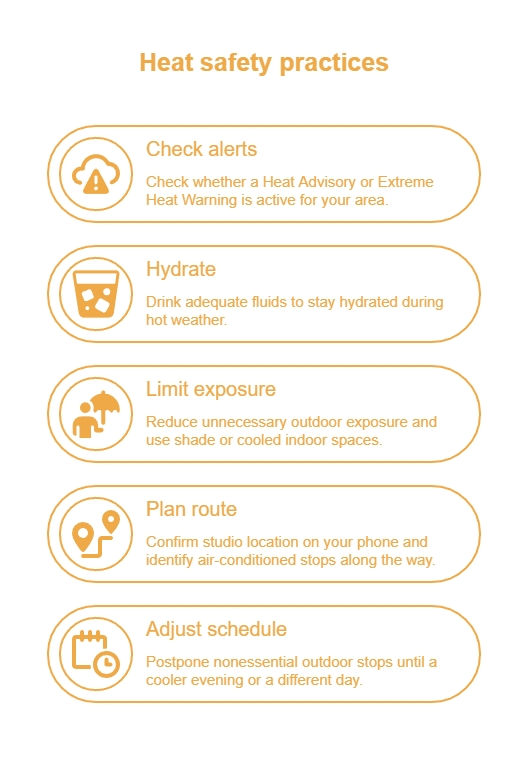
A hot day can change the shape of your trip more than it changes what goes in your bag. Before thinking about belongings, check whether a Heat Advisory or Extreme Heat Warning is active for your area. The National Weather Service publishes current alerts that tell you when outdoor conditions are significant enough to adjust your plans.
If a Heat Advisory applies, the general guidance from both the CDC and the National Weather Service is straightforward: drink adequate fluids, reduce unnecessary outdoor exposure, use shade or cooled indoor spaces when possible, and reconsider strenuous or extended outdoor activity. None of that is piercing-specific medical advice. It is the same heat planning you would use for any outdoor errand.
Build your route with cooling in mind. If you are driving, confirm the studio location on your phone so you are not wandering outside searching for the address. If you are walking or using transit, identify where you can step into shade or air conditioning along the way. If significant heat is expected, plan where you can take a break in a cooled indoor environment rather than assuming every part of the trip will be comfortable. Conditions in Hialeah vary by day and season, so check the current alert before leaving rather than guessing.
Here is what that looks like in practice. Imagine you planned a piercing stop between work and several outdoor errands. That morning, a Heat Advisory appears on the National Weather Service page. A practical response: check the alert, take water, keep the studio address on your phone, and postpone the nonessential outdoor stops until a cooler evening or a different day. You are not canceling the piercing. You are trimming the unnecessary heat exposure around it.
Use the Bring / Confirm / Rearrange Checklist
This is the core planning tool for the visit. Keep it simple: if the studio did not ask you to bring it, you probably do not need it.
Before you leave home: Check the current heat alert. Save the studio location. Confirm booked vs. walk-in. Bring only studio-requested items. Review the rest of your day's plans.
Bring | Confirm | Rearrange if needed |
Drinking water appropriate to your needs | Whether you are booked or planning to use walk-in availability | Unnecessary outdoor errands during a significant heat alert |
Your phone with the studio location and route saved | Any items or documents the studio personally told you to bring | Activities that could conflict with your piercer's current instructions |
Only documents, payment items, or materials specifically requested by the studio | Your current heat alert and transportation plan | Nonessential stops that make the trip after the piercing longer or more complicated |
A short note with questions you want answered | What you should know about the period immediately after leaving | Plans involving required gear or contact near the intended piercing area |
Bring
Water, your phone, and any studio-requested items have obvious practical uses. A short list of questions is also helpful because something that seemed important at home can be easy to forget once you are speaking with the piercer.
What does not belong on this list: a pre-purchased aftercare kit, a specific saline brand, antiseptic products, jewelry you found online, or a bag of supplies recommended by a random article. While Florida law mandates specific documentation for minors and studios require a valid, government-issued photo ID from every client to verify age, there is no universal rule requiring you to bring a particular payment method, appointment confirmation, food, jewelry, or pre-purchased aftercare product. However, while you do not need to pack snacks in your bag, you should always eat a full, nourishing meal 1 to 2 hours before arriving. Eating stabilizes your blood sugar and significantly reduces the risk of fainting in the chair, ensuring a safe and comfortable experience.
Confirm
Before leaving home, check these:
Booked or walk-in? Know your plan. If you booked, confirm the time. For walk-ins, availability is handled as you arrive. While reserving a spot online is an option, you can always just show up.
Any specific instructions the studio gave you. If the team told you to eat beforehand, bring a companion, or prepare anything in particular, follow those instructions rather than a generic guide.
Work gear, glasses, or anything that sits near your nose. If you wear something daily that contacts the area where a piercing would go, bring it or wear it. More on this in the next section.
What the piercer wants you to know about the hours immediately after. If you can ask this before you arrive (by phone or message), you can plan the rest of the day with fewer unknowns.
Rearrange
If the day involves significant heat, consider adjusting the surrounding schedule:
Move optional outdoor errands to a cooler part of the day or a different day entirely.
Postpone or reschedule activities that would make it difficult to follow the piercer's current instructions.
Cut unnecessary stops that lengthen the post-visit trip and keep you outside longer than the day requires.
You are not rearranging because a nose piercing requires bed rest. You are rearranging because general heat-safety planning says to reduce avoidable outdoor exposure when conditions are significant, and because a simpler schedule makes it easier to follow whatever your piercer tells you. Preparation should simplify the day, not create restrictions that were never actually recommended to you.
Think About Anything That Sits or Rubs Near Your Nose
Beyond adjusting your schedule for the weather, physical preparation also means thinking about what goes on your face. If something you wear regularly rests on or near the area where a nose piercing would be placed (glasses, sunglasses, protective eyewear, face shields, respirators, or sports gear), this is a planning step, not a product step.
Consider a reader who wears prescription glasses every day or uses required protective equipment at work. The frames or gear may contact the intended piercing area. The practical action is to bring or wear that item to the studio and show it to the piercer before placement. A professional who sees the contact point in person can evaluate how the jewelry and the accessory will interact, rather than the reader trying to solve the positioning at home.
The broader principle is that unnecessary pressure, friction, or repeated contact around a healing piercing is worth thinking about early. If you know you will need specific face-area gear for work, school, sports, or daily life, that is exactly the kind of detail your piercer should hear before the needle, not after. Bring the gear, explain your routine, and let the professional advise.
The same idea applies if you are helping someone else prepare for the visit. Knowing which glasses, safety equipment, or other required items they regularly wear can be more useful than adding another product to the packing list.
Keep the Post-Appointment Trip Simple
You do not need to cancel every plan or go directly home after a nose piercing. A short, low-key errand is not the same category as ignoring professional aftercare instructions. The goal is to keep the rest of the day flexible enough to follow whatever your piercer tells you.
On a day with significant heat, simplifying the post-visit schedule is primarily a heat-safety decision. Reducing unnecessary time outside in high temperatures is reasonable planning for anyone, regardless of whether they just had a piercing or not. If you had five outdoor stops planned, this is a good day to cut that list to two.
Where the piercing does matter is in the type of activity. If you had plans that might affect a fresh piercing (a gym session, swimming, a dusty outdoor project, or anything involving heavy sweating, submerging your face, or prolonged contact with the piercing area) ask about those specific activities before leaving the studio rather than making assumptions based on conflicting online advice. Do not assume a one-size-fits-all workout, swimming, makeup, or cleaning rule applies. A direct question such as whether a planned activity works with the instructions you were given is more useful than building your day around a general internet checklist. Your piercer's current instructions are the reference, not a generic internet list.
Before You Leave the Studio, Close the Information Loop

The most important thing to bring home from the studio is not the jewelry. It is the aftercare instructions.
Before you walk out, make sure you leave with clear answers to these questions:
What are the current aftercare instructions? Get them directly from your piercer. Online sources, including this article, are not a substitute for the professional's current guidance. Save or photograph the written instructions rather than relying on memory.
Are there activities in the next few days you should adjust? If you have a workout, a swim, a long outdoor shift, or a social event that involves face contact, this is the moment to ask. Work requirements, school, sports, travel, required face gear, or other commitments are easier to discuss when you can describe the actual situation to the piercer.
Who do you contact for piercing-related follow-up? Know whether you call the studio, message them, or walk in if you have a piercing-specific question later.
When should you see a healthcare professional instead? Medical symptoms, signs of infection, or unusual reactions belong with a licensed healthcare professional rather than being diagnosed through online searches.
Follow the current aftercare instructions provided by your piercer, and consult a licensed healthcare professional for guidance on symptoms or medical concerns.
Frequently Asked Questions
What should I bring to a nose piercing appointment on a hot day?
Drinking water appropriate to your needs, your phone with the studio location or booking details saved, any items the studio specifically asked you to bring, and a short list of questions for the piercer. Do not turn the trip into a shopping run for aftercare products before you have received your piercer's current instructions. Confirm any studio-specific requirement rather than assuming it belongs in every person's bag.
Should I buy aftercare products before the appointment?
Not before hearing your piercer's current instructions. Generic aftercare advice online often conflicts between sources. The most reliable approach is to ask your piercer what they currently recommend and purchase only what they specify, if anything.
What should I do if there is a Heat Advisory on the day of my piercing visit?
Check the current National Weather Service alert before leaving. General heat-safety guidance recommends drinking adequate fluids, reducing unnecessary outdoor activity, using shade or cooled spaces, and simplifying your travel plan. A Heat Advisory does not automatically mean you must cancel the studio visit. If the alert level makes you reconsider the visit itself, contact the studio directly rather than assuming you need to cancel.
Your Day, Simplified
Bring less. Confirm more. Simplify the day.
Carry only what the studio asked for (plus water and your phone), confirm the logistics before leaving home, and rearrange the schedule so you are not spending unnecessary time outside in significant heat. Check official heat information rather than guessing, and leave the studio with clear aftercare instructions from your piercer rather than an internet packing list.
If you are ready to schedule your visit, you can book your piercing appointment today. Walk-ins are also welcome on a first-come, first-served basis.
Disclaimer: This article is for general informational purposes only and does not constitute medical advice, diagnosis, or treatment. Readers should consult a licensed healthcare professional for guidance specific to their health, symptoms, medications, or treatment options.
Editorial Process
The Fame Tattoos Insights Team creates educational body art resources based on client questions, studio experience, safety-first standards, and professional research. AI tools may support organization and drafting, but final content should be reviewed, rewritten, and fact-checked by qualified human editors before publication.
About the Fame Tattoos Insights Team
The Fame Tattoos Editorial Team creates clear, safety-conscious body art guides based on studio experience, client questions, and professional aftercare standards. Every guide is reviewed for accuracy, clarity, and practical usefulness before publication.


.jpg)
.jpg)

.jpg)
.jpg)

.jpg)
.jpg)
.jpg)
.jpg)