



Why Implant-Grade Titanium Piercing Jewelry Is a Premier Choice for Your Sensitive Skin
📌 Key Takeaways
Sensitive skin needs verified jewelry, correct fit, clean single-use tools, and steady aftercare to reduce avoidable piercing irritation.
Choose Verified Titanium: Implant-grade titanium can lower irritation risk because it is nickel-free and made for healing tissue.
Question Vague Metals: “Surgical steel” is not enough detail when sensitive skin needs clear proof of jewelry grade.
Fit Comes First: Even safe metal can irritate skin when jewelry is too tight, too long, or poorly shaped.
Clean Setup Matters: Single-use sterile tools make the piercing process clearer, cleaner, and easier to trust.
Aftercare Protects Healing: Calm healing depends on clean hands, less touching, and getting help when irritation worsens.
Less guessing, more verification, and more patience can make piercing healing feel calmer.
Clients with sensitive skin planning a piercing will make safer first choices, guiding them into the jewelry-specific details that follow.
~ ~ ~ ~ ~ ~ ~ ~ ~ ~ ~ ~ ~ ~ ~ ~ ~ ~
Your skin is warning you.
It is 7:00 AM, the bathroom light is too sharp, and the red bump beside your nose jewelry looks more irritated than it did last night. Is this an allergy? Is it infected? Did the jewelry cause it?
If you have sensitive skin, piercing jewelry is not just decoration. It is a material sitting inside healing tissue. Implant-grade titanium piercing jewelry is commonly preferred for sensitive skin because it is nickel-free, highly biocompatible, corrosion-resistant, and recognized in professional piercing jewelry guidance. For a fresh, healing, or irritated piercing, the safest decision is not based on style alone. It depends on verified jewelry material, anatomy-aware fit, proper aftercare, and a studio process built around 100% disposable, single-use sterile equipment.
That combination matters because irritation rarely comes from one thing only. A cheap metal can irritate your skin. Jewelry that is too tight can press into swelling tissue. A hoop installed too early can rub against a fragile healing channel. Touching, twisting, or over-cleaning can add more stress.
The goal is simple: reduce avoidable irritation before your body has to fight it.
What Implant-Grade Titanium Means for Sensitive Skin

Implant-grade titanium is a specific category of titanium used for medical implants and high-quality body jewelry. In professional piercing, ASTM F-136 titanium is one common verification signal.
That sounds technical, but the practical meaning is easy to understand. You are not just choosing a silver-colored stud. You are choosing the material that will stay inside your piercing while your skin is trying to heal.
For sensitive-skin clients, that choice can matter. Nickel exposure is a well-established cause of allergic contact dermatitis. The Mayo Clinic identifies jewelry and body-piercing jewelry as possible sources of nickel exposure, and the American Academy of Allergy, Asthma & Immunology also notes that nickel is a common cause of allergic contact dermatitis.
This does not mean every irritation bump is a nickel allergy. It also does not mean titanium guarantees a perfect healing experience. Individual reactions vary. But as a general principle, verified implant-grade titanium removes a major uncertainty for people who already know their skin reacts poorly to cheap or unclear metals.
Less guessing. Better starting point.
Why “Surgical Steel” Is Not Always Specific Enough
Many people hear “surgical steel” and feel reassured. The word sounds medical. It sounds clean. It sounds like the safest possible option.
The problem is that “surgical steel” is often used as a broad label. Depending on the exact alloy and documentation, some steel jewelry may contain nickel. For clients without sensitivity, that may not create a visible issue. For clients with sensitive skin or known metal reactions, it may contribute to itching, redness, swelling, rash-like irritation, or bumps.
The accurate point is not “all surgical steel is bad.” That would be too broad.
The better point is this: if your skin is sensitive, a vague metal label is not enough. You should know the exact jewelry grade before it is installed. That is especially true for fresh piercings, where the jewelry is not resting on top of the skin like a ring on a finger. It sits inside a healing channel.
Plated jewelry and mystery online jewelry create a similar problem. A piece may look polished in a product photo, but the listing may not prove what the base metal is, how smooth the finish is, or whether the coating can wear down. During healing, those details matter.
Shiny does not always mean skin-safe.
The Metal Purity Quick-Reference Card
Use this as a practical guide before jewelry is installed. The goal is not to become a metal expert. The goal is to ask questions that protect your skin.
Metal label | What it usually means | Sensitive-skin risk | Best use case | What to ask your piercer |
Implant-grade titanium | A verified titanium standard, such as ASTM F-136 when properly documented | Lower risk for many nickel-sensitive clients because it is nickel-free | Fresh piercings, healing piercings, and sensitive-skin jewelry planning | “Can you verify the exact titanium grade?” |
Surgical steel | A broad steel category that can vary by alloy and grade | May contain nickel, depending on the specific material | Only when the exact grade and healing suitability are confirmed | “What grade is it, and is it appropriate for my sensitivity?” |
Plated jewelry | A base metal covered by a thin outer layer | Coating can wear, exposing the base metal underneath | Better reserved for fully healed piercings if approved by a piercer | “What metal is under the plating?” |
Gold-colored or mystery online jewelry | A style description without reliable material proof | Higher uncertainty because alloy, finish, and coating may be unclear | Avoid during healing or active irritation | “Can the seller prove the material?” |
Plastic or acrylic jewelry | Nonmetal jewelry sold for appearance or flexibility | Suitability varies by quality, piercing stage, and use | Not a default choice for fresh or irritated piercings | “Is this appropriate for my piercing stage?” |
The most useful question is direct: “Can you verify the material before it goes in?”
If the answer is vague, slow down. A professional piercer should be able to explain what the jewelry is, why it fits your piercing stage, and how the size was chosen for your anatomy.
Material Quality Is Only One Part of a Safe Piercing
Implant-grade titanium can reduce one major risk variable for sensitive-skin clients. It does not replace good placement, correct sizing, or a clean studio process.
This is where Fame Tattoos’ safety positioning matters. The studio’s approach emphasizes high standards of hygiene, often utilizing 100% disposable, single-use sterile equipment for each client. This practice provides a transparent and efficient safety baseline, as the equipment is opened for one client, used once, and discarded. While some professional studios also utilize reusable medical-grade instruments processed through strict autoclave sterilization, single-use equipment removes the need for clients to verify individual sterilization records for tools, simplifying the safety picture for those new to the process.
For clients, that creates a simpler safety picture. Single-use sterile equipment removes the need to wonder what happened to a tool before your appointment. It also supports a more transparent experience because the client can understand the process at a glance: fresh supplies, one client, one use.
That is especially important when you are already anxious about sensitive skin. You should not have to worry about both the jewelry and the setup. A safer piercing experience should make the key variables clear before the procedure begins.
Material. Fit. Fresh single-use sterile equipment. Aftercare.
Those are the pillars.
Why Jewelry Fit Matters as Much as Metal
A perfect material can still become a problem if the jewelry does not fit your anatomy.
A nostril piercing has to work with tissue thickness, nostril crease height, placement angle, swelling room, and the shape of the jewelry itself. If a stud is too short, swelling can press against it. If it is too long, it may move more than necessary and create friction. If a hoop goes in too early, the curve of the ring can rub against a channel that is still healing.
That is why the trendiest jewelry is not always the right first jewelry.
A tiny hoop may look good in a photo. It may not be right for your piercing today. A low-profile stud may seem subtle and cute. It may not leave enough space for swelling. Good piercing decisions are made around your body first and the final look second.
Fame Tattoos’ guide to nose ring sizing and facial anatomy explains why the same jewelry diameter can look and feel different from person to person. The related article on early hoop change risks also reinforces a widely accepted piercing principle: a piercing may look calm on the outside before the inner channel is ready for a shape change.
That can be annoying. It is also useful.
Healing is not a styling race.
How Cheap or Unclear Metals Can Make Bumps More Confusing
A bump beside a piercing can make anyone nervous. On the face, it feels even worse because it is visible every time you pass a mirror.
But a bump is not automatically a keloid. It is not automatically an infection either. As a general principle, piercing bumps can appear when the tissue is irritated, and irritation can come from more than one source.
Common contributors may include:
Jewelry with unclear metal content
Nickel exposure in sensitive clients
Jewelry that is too tight, too long, or poorly angled
A hoop installed before the piercing is ready
Friction from towels, masks, makeup, or sleeping pressure
Touching, twisting, or over-cleaning
Aftercare that does not match the piercing stage
This is why guessing at home can backfire. If you assume the bump is only a metal issue, you may miss a fit problem. If you assume it is only a cleaning issue, you may keep irritating the tissue. If you switch jewelry too soon, you may add fresh trauma to an already irritated piercing.
A bump is a signal to check the variables.
Fame Tattoos’ internal guide on healing bumps versus keloids is useful if you are trying to understand why a bump can appear and why cheap jewelry can make the situation harder to read.
What to Ask Before the Piercing Starts
A careful piercer should welcome informed questions. You are not being difficult when you ask about the material, the fit, or the setup. You are protecting your skin.
Before the piercing starts, ask:
What exact grade is this jewelry?
Is it implant-grade titanium?
Is it appropriate for an initial or healing piercing?
How are you choosing the size for my anatomy?
Does this jewelry leave enough room for swelling?
Is this shape better for healing, or mainly for style?
Will the equipment used for my piercing be sterile, disposable, and single-use?
What should be avoided during healing?
When should a professional check the piercing if irritation starts?
Those questions do not require advanced knowledge. They require clear answers.
Fame Tattoos provides this level of professional guidance for the Hialeah and Miami communities. Walk-ins are accepted on a first-come, first-served basis, and clients who want to plan ahead can use the piercing request/booking path.
The important part is not whether you walk in or plan ahead. The important part is that your jewelry, anatomy, aftercare, and single-use sterile setup are treated as part of the same safety conversation.
Aftercare Still Matters After the Right Jewelry Is Installed
Good jewelry gives your piercing a better starting point. Aftercare protects that starting point.
Fame Tattoos’ piercing aftercare instructions emphasize washing your hands before cleaning or touching a piercing, cleaning facial and ear piercings consistently, and avoiding habits that disturb the healing area. The aftercare guidance also warns against unnecessary touching, picking at scabs, submerging the piercing during the restricted period, shaving over the area too soon, and using products that contain petroleum or isopropyl alcohol.
These details matter because irritation can stack. A sensitive-skin client may start with the wrong jewelry, then add friction, early movement, and over-cleaning. By the time a bump appears, there may be several causes working together.
Keep the plan simple. Use verified jewelry. Let the piercing settle. Keep hands away unless cleaning. Follow the aftercare guidance from your piercer. Ask for a professional check if the piercing gets worse instead of gradually calming down.
Simple does not mean casual. It means consistent.
When an Irritated Piercing Needs Professional Help
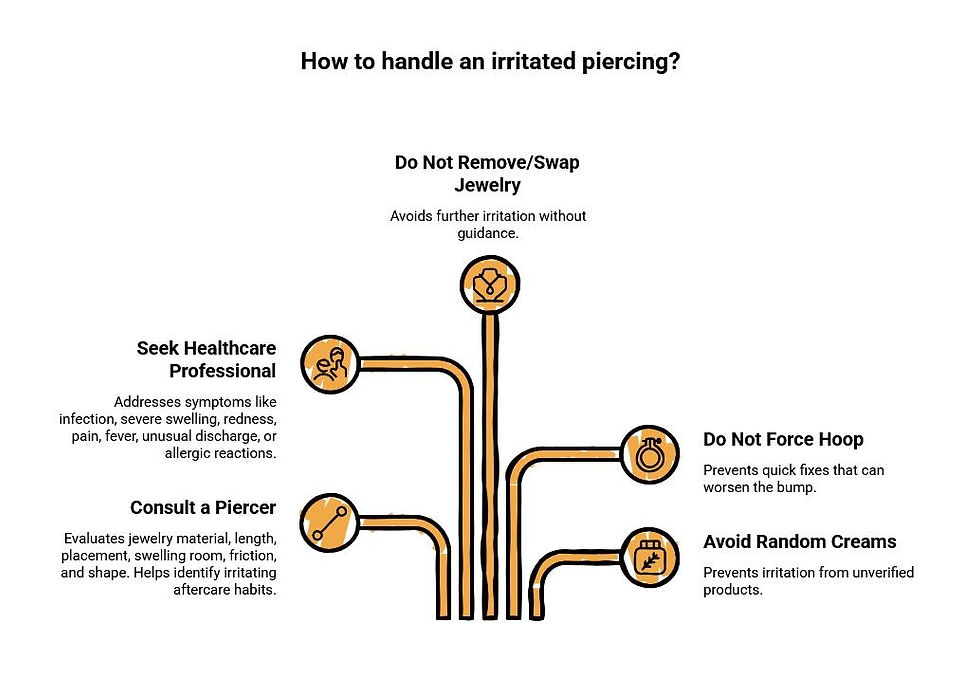
An irritated piercing should be handled carefully. A piercer and a healthcare professional play different roles.
A qualified piercer can evaluate jewelry material, jewelry length, placement angle, swelling room, friction, and whether the shape is appropriate for the healing stage. They can also help you spot aftercare habits that may be irritating the piercing.
A licensed healthcare professional is the right person for symptoms that may involve infection, severe swelling, spreading redness, significant pain, fever, unusual discharge, or a suspected allergic reaction. Piercing professionals can evaluate jewelry and mechanics, but they do not replace medical care.
Do not remove or swap jewelry during active irritation without guidance. Do not force in a hoop because you want the bump to disappear quickly. Do not cover the area with random creams or harsh products because a stranger online said it worked.
Your face is not the place for experiments.
If you want to know what a safer setup should look like before you sit down, Fame Tattoos’ guide on safe piercing setup can help you understand the kinds of questions and visual cues that support a more confident visit.
Choosing Jewelry When You Have Sensitive Skin
Sensitive skin does not mean you cannot have a beautiful piercing. It means the first decision needs more care.
Start with verified implant-grade titanium when possible. Ask for the exact grade. Ask whether the jewelry is appropriate for your piercing stage. Ask how the size was chosen. Ask whether your setup uses 100% disposable, single-use sterile equipment. Ask what signs should bring you back for a professional check.
Then give the piercing time.
The best-looking piercing is not always the one with the flashiest jewelry on day one. Often, it is the one that healed with the least drama because the first choice was careful: clean material, correct fit, enough swelling room, and a process designed to reduce avoidable risk.
That is not boring. That is smart.
For clients in Hialeah and the Miami area, Fame Tattoos can help connect piercing style with safer material choices, anatomy-aware fit, and a disposable-only sterile process. Before choosing new jewelry, read the aftercare and sizing resources first. A few minutes of preparation can prevent weeks of mirror-checking and second-guessing.
Frequently Asked Questions About Implant-Grade Titanium Piercing Jewelry
Is implant-grade titanium better than surgical steel for sensitive skin?
For many sensitive-skin clients, verified implant-grade titanium is the preferred starting point because it is nickel-free and more specific than the broad label “surgical steel.” Surgical steel is not automatically wrong for every person, but sensitive clients should ask for the exact grade before using it in a new or healing piercing.
Can someone still react to titanium jewelry?
Individual reactions vary. Implant-grade titanium is widely used because it is highly biocompatible, but no jewelry material can guarantee the same result for every person. Persistent redness, swelling, pain, or suspected allergy should be evaluated by a qualified piercer or licensed healthcare professional.
What does ASTM F-136 mean?
ASTM F-136 is a material standard used to identify a specific type of implant-grade titanium alloy. For piercing clients, it works as a verification cue. Instead of accepting a vague label like “hypoallergenic,” you can ask whether the jewelry is ASTM F-136 implant-grade titanium.
Is implant-grade titanium good for a new nose piercing?
Implant-grade titanium is commonly preferred for new nose piercings, especially for sensitive-skin clients, because it avoids nickel exposure and is recognized in professional piercing jewelry guidance. The jewelry still needs the correct size, shape, finish, and placement for your anatomy.
Will titanium fix an existing piercing bump?
Titanium may help if low-quality or nickel-containing jewelry is part of the irritation. It will not fix every bump by itself. A bump can also come from pressure, friction, early hoop changes, poor fit, or aftercare problems. A professional check is the safest next step before changing jewelry.
Why does single-use sterile equipment matter?
Single-use sterile equipment supports a cleaner, clearer piercing process because the equipment is used for one client and then discarded. For clients, that reinforces transparency and reduces concern about what happened before the appointment. It also aligns with Fame Tattoos’ disposable-only safety positioning.
Should jewelry be changed at home if a piercing is irritated?
Active irritation should be evaluated before jewelry is changed. Removing or swapping jewelry at home can add trauma, trap a problem, or make the piercing harder to assess. A qualified piercer can check whether the material, length, shape, or placement is contributing to the irritation.
A Calmer Way to Choose Piercing Jewelry
Go back to the mirror for a moment.
The goal is not to stare at a red bump and guess what your skin is trying to say. The goal is to understand the key variables before irritation starts: verified material, anatomy-aware fit, 100% disposable single-use sterile equipment, and aftercare that gives the piercing room to heal.
Implant-grade titanium piercing jewelry gives sensitive skin a stronger starting point. Professional sizing helps that jewelry sit correctly. A disposable-only sterile process supports a cleaner, more transparent experience. Clear aftercare protects the piercing after you leave the studio.
That is the shift: less guessing, more verification. Less panic, more patience. Less trend-first jewelry, more body-first care.
Choose the metal your skin does not have to fight.
Disclaimer: This article provides general information about implant-grade titanium piercing jewelry, sensitive-skin piercing concerns, disposable single-use sterile piercing practices, and jewelry material selection for educational purposes. Individual reactions vary based on metal sensitivity, placement, jewelry fit, aftercare habits, and healing stage. For persistent redness, swelling, pain, discharge, suspected infection, or allergic reaction, consult a qualified piercer or licensed healthcare professional.
Our Editorial Process:
Our expert team uses AI tools to help organize and structure our initial drafts. Every piece is then extensively rewritten, fact-checked, and enriched with first-hand insights and experiences by expert humans on our Insights Team to ensure accuracy and clarity.
By: Fame Tattoos Insights Team
The Fame Tattoos Insights Team is our dedicated engine for synthesizing complex body art, piercing, aftercare, and safety topics into clear, helpful guides. While our content is reviewed for clarity and accuracy, it is for informational purposes and should not replace professional advice from a qualified piercer or licensed healthcare professional.


.jpg)
.jpg)

.jpg)
.jpg)

.jpg)
.jpg)
.jpg)
.jpg)