



Hair Tattoo Photos and Design Previews: What to Verify with Hialeah and Miami Providers
Updated: 2 days ago
📌 Key Takeaways
The author recommends checking photo timing, shooting conditions, and preview limits before letting hair tattoo images shape your expectations.
Photo Timing Changes Meaning: A fresh photo shows one stage; an unlabeled image leaves you guessing about when someone took it.
Matching Conditions Improve Comparisons: Lighting, distance, angles, and hair length can change how the same result looks across photos.
Similar Clients Offer Context: Examples with similar hair patterns and skin tones offer context, but they cannot predict your personal result.
Previews Propose Hairline Shapes: A design preview helps you discuss shape and placement, but it cannot guarantee your final appearance.
Photos Cannot Prove Safety: Portfolio images cannot confirm safety practices or qualifications; the author recommends discussing these separately with providers.
Photos provide context; previews offer proposals, not promises.
People considering hair tattoos in Hialeah or Miami will find questions for comparing provider images in the checklist below.
~ ~ ~ ~ ~ ~ ~ ~ ~ ~ ~ ~ ~ ~ ~ ~ ~ ~
A hair tattoo photo can show what one result looked like in one moment; it cannot, by itself, tell you how the same design would look on you. If you are saving gallery images from Hialeah providers, close that gap before any image shapes your expectations.
Scalp micropigmentation (SMP), sometimes called a hair tattoo, is a cosmetic procedure that places pigment in the scalp. Before treating any SMP image as a comparison point, find out when it was taken, how it was captured, and what the provider says it cannot predict. A design preview needs the same scrutiny because it is a proposal for your hairline rather than a record of anyone's result. Throughout the process, you can ask for context, take notes, and pause before deciding; an in-person review does not obligate you to proceed.
What a Hair Tattoo Photo Can Show, and What It Cannot

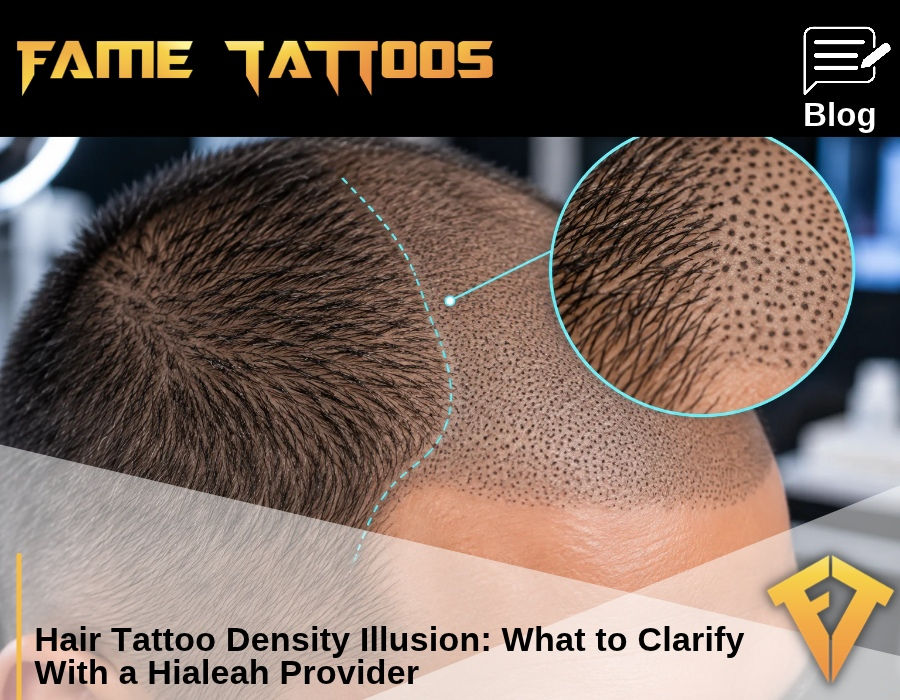
Treat every portfolio image as real evidence with missing context. It can show the hairline shape in that frame, apparent density at that distance, and the contrast between pigment, scalp, and existing hair, all for one client under one set of conditions.
On its own, a photo cannot show how the result looks in other lighting or from other angles, how it changed over time, or whether it was edited. It cannot confirm that you are a comparable candidate or that the same outcome suits you. A polished portfolio also cannot prove a provider's safety practices, credentials, or qualifications, which are separate questions that require direct confirmation.
Portfolios are also curated, so the most striking photo is a selected example, not a typical one. Customer review photos can add perspective but raise the same questions.
That does not make provider photography unreliable. Each image simply needs its origin and history (when it was taken and whether it was changed) before it carries weight. Ask: What facts about this photo should I know before I use it as a comparison?
An image shows the hairline shape, density, and contrast in that specific frame, on that person. It suggests how the design might read at that distance and in that light. However, timing, provenance, editing history, other angles, lighting, relevance to you, and factors requiring an in-person assessment remain unknown.
Work through each image in order: note what is shown, list what is missing, test comparability, separate appearance from assumption, and carry open questions into an in-person visit.
First, Verify When the Photo Was Taken
Ask for the timing before you judge the appearance: "When was this image taken relative to the service?" An image taken right after a session shows a fresh result; one from a later follow-up shows a later-stage result, sometimes described as healed. For example, a fresh result often features darker, sharper pigment dots and mild scalp redness. Once healed, the redness subsides and the pigment dots soften, spreading slightly beneath the skin to look more like natural hair stubble. Anything unlabeled falls into a third category: timing not disclosed. Even a caption that says only "after" leaves the stage unclear.
Consider two gallery images, one captioned "taken immediately after the session" and one with no caption. The first tells you its stage; the second leaves you guessing, however convincing it looks. Across a whole gallery, check that every example you compare carries the same kind of label.
For a before-and-after pair, ask, "Is this the same client and the same treated area?" Then ask, "Were any other changes made between the photos, such as haircut, hair length, styling, lighting, framing, or head position?" Each of those can alter the appearance independently of the SMP work.
If a pair shows only one stage, ask, "Do you have a later image of this result?" Some providers can share several stages for one client, subject to consent. Even then, a timing label describes one person's photos rather than forecasting how every result changes.
Compare the Same Result Under Comparable Conditions
Compare capture conditions before comparing results, since they shape how density and contrast read on a screen.
Condition | What to match across images |
Timing | The same labeled stage |
Lighting | Similar direction and brightness |
Distance and zoom | The same camera distance |
Crop | Similar framing of the head and face |
Angle and head position | Matching front, side, and top positions |
Hair length and styling | Unchanged, or disclosed |
Editing | The same treatment, with any changes to contrast, sharpness, smoothing, filters, or retouching disclosed |
Take a typical pair of photos from one client and one visit: a bright, tightly cropped hairline close-up, and a wider shot under ordinary indoor lighting. Neither is deceptive or more truthful than the other, but only the wider one shows how the hairline sits within the whole head and face, and together they tell you more than either does alone. Because video is more difficult to heavily edit or perfectly light than a still photograph, ask if the provider has video footage of the same client. Watching how the hairline catches the light as the person turns their head provides a more realistic sense of three-dimensional density.
A phone screen favors close-ups, and social platforms may compress or sharpen images. Ask, "Can I see this from a normal conversational distance?" and "Can I see the original image file or another image from the same session?"
Several views of one client tell you more than a row of unrelated examples, so ask, "Can I see the front, both sides, and top under similar lighting?" If a provider shares only a front view, asking "Do you have a side or top view of this client?" is a routine follow-up, not an accusation.
Ordinary cropping and exposure correction are common, so treat editing as a plain question rather than a suspicion: "Were these images edited beyond ordinary cropping or exposure correction?" Inconsistent photography makes examples harder to compare; it does not, by itself, show that the work is poor or that the images were manipulated.
Ask Whether the Example Is Actually Relevant to You
A strong portfolio image can still be a weak personal comparison, so start here: "Why do you consider this example relevant to my situation?" A comparable example is one whose starting point and goals resemble yours closely enough to mean something. That depends on your existing hair pattern, hairline goal, hair color, skin tone and visible contrast, the amount and distribution of thinning, any scars or other scalp features, and how you want the result to look up close and at normal distance.
Someone might find a portfolio hairline with the shape they want, on a client whose hair and skin contrast differs noticeably from theirs. The shape is a relevant reference; the overall appearance may not be, and only asking reveals which parts transfer.
Follow up with "Can you show examples with similar hair and skin contrast?" and "Can you show a similar starting pattern?" Then ask, "What parts of this example are not comparable to me?" and "What needs to be assessed in person?"
Visual similarity is a starting point for conversation, not evidence of candidacy. A qualified provider can assess your scalp and goals in person, and a licensed healthcare professional can address medical concerns.
Treat a Design Preview as a Conversation Tool, Not a Prediction

A design preview is a proposal for your hairline, not a prediction of your result. Unlike a portfolio photo of someone else's past result, a hairline preview is made for you to support a design discussion. Start by asking whether a preview is available and what form it takes: "Is this preview a drawing, digital overlay, temporary marking, or another format?" Don't assume any provider offers a particular method until they confirm it.
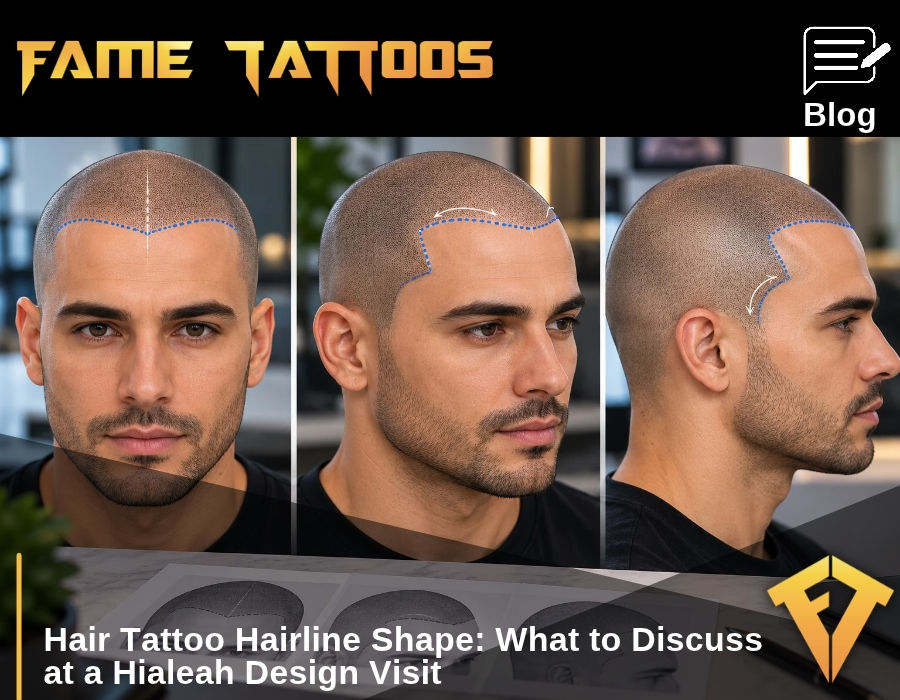
A preview can help you and the provider discuss hairline height, basic contour, symmetry, proportion, and placement, along with whether you prefer a softer or sharper frame. Ask, "Can the shape be adjusted before I decide?" and "Will I see the proposal from more than one angle?"
A preview does not guarantee an outcome. It does not capture final pigment appearance, exact density, healing, long-term appearance, or how the design reads in three dimensions under every kind of light. It cannot determine whether the procedure suits you, and it says nothing about procedural safety.
A sharp digital overlay, for instance, illustrates shape clearly while leaving texture and real-world lighting outside what it depicts. Ask, "What is this preview designed to illustrate?" and "Which parts remain subject to an in-person assessment?" A careful answer that names what remains uncertain is more useful than a confident promise.
Use This Photo and Preview Verification Checklist
Most misreadings of SMP images come from three mistakes: ignoring timing, comparing images captured under unequal conditions, and treating a preview as a guarantee. Use these scalp micropigmentation consultation questions to avoid all three. Anyone comparing photo sets from three regional providers could ask each the same questions, making answers comparable without ranking anyone. Note each answer beside its row as shown, suggested, or still unknown.
What You Are Viewing | Ask This | It May Demonstrate | It Does Not Resolve |
Fresh image | When was this taken? | Appearance right after a session | How it looks at a later stage, or your likely result |
Later-stage image | How is this stage labeled? | One later appearance for one client | How your own result would change, or a universal timeline |
Before-and-after pair | Same client and area? Were capture conditions comparable? | One person's change | What else changed between shots, or what caused each difference |
Close-up | Can I see a wider view? Was the image edited? | Detail at close range | Appearance at conversational distance |
Wider view | Was the lighting similar? Can I see a closer image from the same session? | How the hairline sits within the face | Fine detail, or appearance in other lighting |
Front or profile angle | Can I see more angles? | The design from that direction | Angles not shown |
Similar-client example | Why is this relevant to me? What is not comparable? | A closer comparison point | Your candidacy, suitability, or expected outcome |
Proposed preview | What does it illustrate, and what does it leave unresolved? | Shape, placement, and proportion | Final appearance, exact density, healing, suitability, or a guaranteed result |
Safety or process statement | What current process and qualifications can you explain? | What the provider says it does | Safety, credentials, or qualifications based on a photo alone |
Unknown timing or provenance | Where is this from, and was the image edited? | Little on its own | Ownership, editing history, representativeness, and most of its meaning |
Photos do not verify a provider's safety practices. Fame Tattoos states that it uses 100% disposable, single-use sterile equipment. That statement describes its stated practice rather than a guarantee of safety or outcome, so ask providers to explain their current process directly.
Close by asking, "What needs to be checked in person?" If a full photo set cannot be shared, consent and privacy may be the reason, and a missing view is not automatically a problem; ask whether anonymized or differently framed examples are available. Ask for plain-English explanations of technical terms. Treat superlatives, result guarantees, or claims that every client can expect a similar look as prompts for more questions, not evidence.
Asking clearly is ordinary informed-consumer behavior, and the checklist identifies open questions rather than scoring anyone.
Common Questions About SMP Photos and Previews
How can I tell whether a scalp micropigmentation photo is healed?
You usually cannot tell confidently from appearance alone. Ask the provider when the image was taken, whether they consider it a fresh or later-stage result, and whether a later follow-up image of the same client exists. Without verified timing, avoid assigning an exact healing timeframe based on the photograph alone. Questions about healing, fading, or how long a result lasts belong in an in-person conversation, and medical concerns belong with a licensed healthcare professional.
Should I ask to see hair tattoo photos from several angles?
Yes. Ask for a close-up and a wider view, plus front, side, or top angles that make sense for the treated area. Matching lighting and distance across those views helps you see what genuinely changes from one angle to the next. A complete set still describes one client, so treat it as stronger context rather than a prediction of your own result.
Does a scalp micropigmentation design preview show exactly how I will look?
No preview should be treated as an exact forecast of your appearance. A preview may help you discuss shape, placement, proportion, and hairline preferences with a provider. Before relying on one, ask which variables it does not simulate and whether it takes your existing hair and scalp into account. Anything the preview leaves out still depends on an in-person assessment.
Use the Image to Start Better Questions
A useful photo is clearly labeled and placed in context, and a useful provider conversation covers what the image cannot establish. You do not need to decide based on one image, one preview, or one consultation, and asking for context does not commit you to treatment. If Fame Tattoos is on your list, its hair micropigmentation service page is one place to begin collecting questions.
Save the checklist and bring it to an in-person Hialeah or Miami consultation. Ask the provider to label each example by timing, show comparable angles, and explain what the images still cannot answer.
Disclaimer: This article provides general educational information about evaluating scalp micropigmentation photos and design previews. It does not provide medical advice, determine whether a procedure is suitable for you, or predict an individual result. Appearance, healing, suitability, and procedural risks can vary. Discuss your circumstances with a qualified provider, and consult a licensed healthcare professional about medical concerns.
Editorial Process
The Fame Tattoos Insights Team creates educational body art resources based on client questions, studio experience, safety-first standards, and professional research. AI tools may support organization and drafting, but final content should be reviewed, rewritten, and fact-checked by qualified human editors before publication.
About the Fame Tattoos Insights Team
The Fame Tattoos Editorial Team creates clear, safety-conscious body art guides based on studio experience, client questions, and professional aftercare standards. Every guide is reviewed for accuracy, clarity, and practical usefulness before publication.

.jpg)
.jpg)

.jpg)
.jpg)

.jpg)
.jpg)
.jpg)
.jpg)