



Nose Piercing Questions Athletes Should Ask Before Booking in Hialeah
📌 Key Takeaways
A nose piercing works best for athletes when the booking date fits training, rules, gear, and aftercare from day one.
Plan Around Training: Book during a lighter stretch so sweat, contact, and travel do not disrupt early healing.
Check Rules First: Confirm school, team, league, or employer jewelry rules before getting pierced.
Respect Gear Friction: Helmets, masks, goggles, and headgear can rub a fresh piercing and slow healing.
Avoid Water Plans: Pools, beaches, hot tubs, saunas, and steam need a 60-day pause after piercing.
Delay The Hoop: A hoop may be the goal, but healing and placement decide when switching makes sense.
Better timing now means fewer conflicts later.
Hialeah athletes planning a nose piercing will make smarter booking choices, preparing them for the detailed overview that follows.
~ ~ ~ ~ ~ ~ ~ ~ ~ ~ ~ ~ ~ ~ ~ ~ ~ ~
An athlete can want a nose piercing the same way they want anything else—with a specific look in mind and a general assumption that it'll work itself out. What actually needs working out is the schedule. Practice calendars, contact risk, gear friction, team policies, and South Florida's proximity to water all shape whether a chosen booking date is genuinely practical or just optimistic.
Most of those concerns are manageable when discussed with a professional piercer before booking. Skipping that conversation can mean a difficult season, a forced choice between jewelry and a coach's directive, or a healing process disrupted by a variable that was entirely predictable.
What Should Athletes Ask Before Booking?

Before any appointment, work through this list:
What sport or activity, and how often?
Does training involve contact, impact, or pressure near the nose?
How long should intense workouts or heavy sweating be avoided after piercing?
Will the team, school, employer, or league allow visible jewelry during competition?
Are there pool, beach, ocean, or hot tub plans in the next 60 days?
What starter jewelry is most practical for the specific activity level?
When can jewelry be safely changed?
Is there a competition, tournament, recital, photo day, or travel block coming up soon?
These aren't rhetorical. They're the inputs a piercer needs to move from generic advice to sport-specific guidance.
Timing Is a Training Decision
The most preventable mistake is booking at the wrong point in the season. Whether it's a state meet in three weeks, a full week of HIIT camp, or the opening stretch of a contact-heavy schedule, a compressed window between piercing and peak demand makes the early healing phase harder.
Fame Tattoos' aftercare instructions advise avoiding excessive sweating for at least one week after a nose piercing and note that healing varies by client and piercing type. That one-week window is an early minimum, not a finish line. Building breathing room on either side—booking during a natural off-season break or a lighter training stretch—gives healing a far better foundation than the week before a regional competition.
Healing timelines aren't fixed guarantees, so avoiding plans built around a specific number of days is the more practical approach. The goal is a window where aftercare is genuinely manageable, not just theoretically possible.
Athlete situation | Question to ask before booking | Why it matters |
Contact sport (wrestling, boxing, football, MMA, soccer) | "Will face contact affect timing or placement choices?" | Helps plan around sparring, drills, and game schedules |
Helmet, mask, or faceguard user | "Will my gear press or rub near the piercing site?" | Repeated pressure during healing can cause irritation |
Swimmer or water-sport athlete | "How does my swim schedule affect when I should book?" | Fame Tattoos' aftercare requires avoiding submersion for at least 60 days |
High-sweat athlete | "Can I manage the first week of aftercare around training?" | Fame Tattoos' aftercare advises avoiding excessive sweating for at least 1 week |
School or competitive uniform rules apply | "Will I need to remove jewelry for practice or competition?" | Rules at the organization level—not the studio—determine whether now is the right time |
Dance, cheer, or performance | "Will makeup, costumes, photos, or close visibility matter?" | Appearance rules and styling expectations can affect both timing and jewelry choice |
Gear, Contact, and What Performance Athletes Often Overlook
Contact sports carry a concrete, predictable concern: accidental face contact is part of the sport. Wrestling, boxing, football, basketball, soccer, and martial arts all involve a realistic possibility of contact near the nose during practice or competition. That isn't a reason to avoid getting pierced—it's a reason to describe the training environment accurately so the piercer can factor it into any guidance on timing and placement.
Athletes who wear gear face a different problem. A helmet, face mask, goggle strap, or padded headgear that regularly sits near the nose or bridge can press or rub against a fresh piercing throughout early healing. When that friction is repeated over days or weeks, it can trigger an irritation bump—a raised area near the piercing site that develops from pressure or movement. While these are often distinct from infections, they can hinder the healing process and should be evaluated by a professional piercer to determine if a jewelry adjustment or repositioning is necessary. Describing specific gear before booking is the simplest way to anticipate this.
Performance athletes—dancers, cheerleaders, pageant competitors, and stage performers—encounter a less obvious version of the same problem. Makeup applied close to the nose during rehearsals, quick costume changes that brush fabric across the face, and the physical demands of a performance-heavy week all affect the environment around a fresh piercing in ways a gym-goer would not encounter. Bringing those specifics to the consultation gives the piercer a complete picture rather than a partial one.
Aftercare in an Athlete's Real Schedule
For an athlete, aftercare does not happen in a quiet bathroom at 8 PM. It happens in a locker room after a two-hour practice, on a tournament travel day, and on a school morning with fifteen minutes before the bus leaves. Fame Tattoos' aftercare instructions include washing hands thoroughly before cleaning or touching a piercing, cleaning the area at least twice a day using the proper technique, and avoiding unnecessary touching. The practical question is whether that routine fits the athlete's actual daily structure.
Before booking, ask how to handle a situation where a full cleaning is not immediately possible after a workout, what to do if sunscreen, field dirt, or shared-surface sweat gets near the piercing, and which products—including soaps with dyes or fragrances—should be avoided entirely. A detailed daily reference is available in this piercing aftercare checklist.
Student athletes and younger competitors often benefit from having a parent or guardian involved in this part of the planning. Reviewing aftercare instructions together before the appointment means the at-home environment during school weeks and evening practices actively supports healing instead of working against it. Weight lifters, runners, HIIT participants, and cyclists who train daily should also ask specifically about managing care around back-to-back training days, since an interrupted cleaning routine carries its own risks.
For general piercing standards and aftercare principles that apply across professional studio settings, the Association of Professional Piercers' aftercare guidance publishes widely recognized industry standards worth reviewing before any piercing appointment.
Pools, Beaches, and 60 Days in South Florida
This constraint matters more in Hialeah and Miami than almost anywhere else. Pools, ocean access, and beach weekends are not occasional events here—they are routine. Fame Tattoos' aftercare instructions are explicit: avoid submerging a fresh piercing in water, saltwater, pools, hot tubs, saunas, and steam for a minimum of 60 days.
For a competitive swimmer, lifeguard, water polo player, or anyone spending regular weekends at the beach, that 60-day window is a hard planning constraint. Booking the week before aquatics season starts—or three days before a beach trip—creates an immediate conflict with early aftercare that cannot be undone afterward. This post on swimming after a Miami nose piercing explains the reasoning in detail.
Jewelry Rules Belong to the Organization, Not the Studio
A piercer can explain the risks of removing fresh jewelry early. What no piercer can confirm is whether a specific team, school, league, or employer allows visible nose jewelry during competition or practice. Those rules vary too widely and change too often for any outside party to answer on behalf of an organization.
Before booking, verify directly whether visible jewelry is permitted during practice and games, whether taping qualifies as a compliant alternative under the specific rulebook or is explicitly prohibited, and whether retainers are recognized as acceptable. This applies equally to a high school wrestler navigating state athletic association policies, a dancer in a company with costuming standards, and a student-athlete whose coach interprets uniform rules independently of the official handbook.
Being asked mid-season to remove a fresh piercing—because a referee flags it at a meet or a coach notices it during warmups—creates a complication that a brief pre-booking inquiry to the right authority prevents entirely. For context on what a professional consultation at a Hialeah studio typically addresses, this post on Hialeah piercing safety protocols covers the intake process in detail.
Placement, Starter Jewelry, and When a Hoop Is Realistic
Nose piercings are not a single placement. A standard nostril sits differently than a high nostril—a placement higher on the nasal wall that may position the jewelry closer to where certain goggles, sports masks, or glasses naturally rest. Understanding the anatomy mapping process before booking helps athletes anticipate whether the planned placement creates additional gear friction. This guide to nose piercing anatomy mapping explains how piercers evaluate placement based on individual anatomy.
Fame Tattoos uses sterilized surgical steel jewelry. For nose piercings, we advise waiting 4 to 6 months for a general jewelry swap, and a strict 6 to 9 months before swapping an initial stud for a hoop, as healing varies by person and piercing. For athletes, the starter jewelry conversation should include asking whether the fit accounts for normal healing swelling, whether the style is likely to catch on a towel, uniform, or protective gear during training, and what the piercer looks for before recommending a change.
The hoop question comes up often because it is usually the look the athlete actually wants. The timing of that transition depends on anatomy, placement, and individual healing progress—not a fixed calendar date. Asking the piercer at the consultation what signs indicate readiness is more reliable than working from a number of weeks. Why a nose piercing may not be ready for a hoop yet explains the evaluation process behind that decision. For athletes focused on the long-term look, why swapping your nose ring too early affects the final result offers additional context on why jewelry timing matters beyond healing alone.
Bring This to Your Piercer
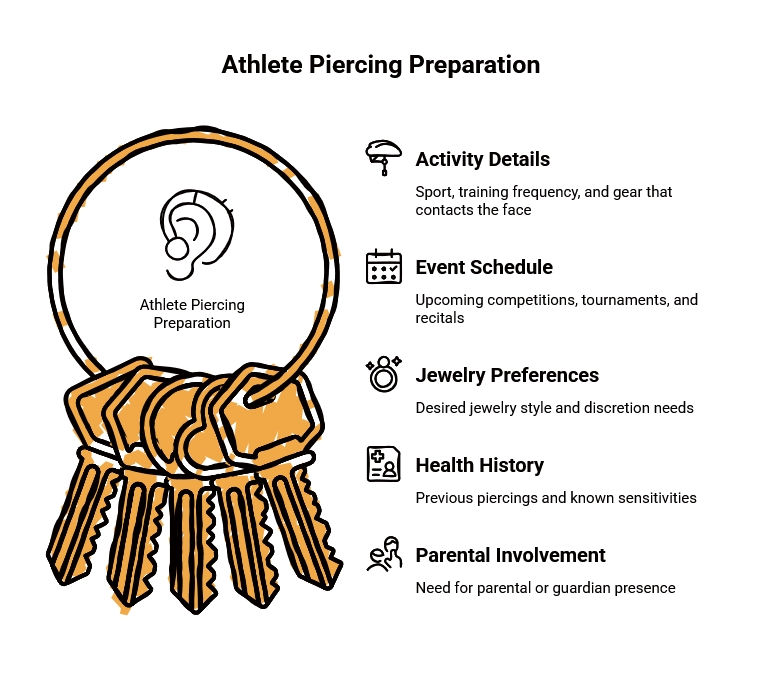
Sport or activity and training frequency
Upcoming competition, tournament, recital, or event dates
Gear that contacts the face during practice (helmet, mask, goggles, headgear)
Team, school, league, or employer rules on jewelry visibility
Swim, beach, or water plans for the next 60+ days
Whether training involves back-to-back high-sweat days
The jewelry style you eventually want
Any previous piercing history or known sensitivities
Whether the piercing needs to remain discreet for certain events
Whether a parent or guardian should be part of the consultation
For Hialeah Athletes: Starting the Conversation
Fame Tattoos offers nose piercings in Miami and Hialeah, including nostril and septum options, with nose piercing pricing from $55 to $70. Piercings are walk-in, first come, first served—no appointment is needed to come in, ask questions, and get a realistic read on timing before committing. A booking option is also available through the piercing page for athletes who prefer to plan around a specific date.
Have a sport, schedule, or gear concern before getting pierced? Bring your questions to a professional piercer before booking your nose piercing.
Book When the Schedule Actually Supports It
Athletes who have the smoothest experiences are generally the ones who checked the calendar before booking, confirmed their organization's rules before the appointment, and walked into the studio with their sport situation already explained. A nose piercing that works with an active lifestyle is not a matter of luck.
Healing can vary considerably from person to person, so building plans around a guaranteed timeline is less useful than finding a window where aftercare is genuinely manageable from day one.
Frequently Asked Questions
Can athletes get a nose piercing during the active season?
It depends on the sport, the schedule, and whether early aftercare can realistically be followed during that period. Athletes in the middle of a contact-heavy or high-sweat season often find that waiting for a natural break produces fewer complications. The better question to bring to a piercer is not whether it can be done mid-season—it is whether the specific upcoming weeks create conditions where a fresh piercing can be cared for properly.
What information should be shared with a piercer before booking for a contact sport?
Describe the sport, typical training frequency, the type of face contact that is realistic during practice, and any gear worn near the nose or face. That context allows the piercer to discuss timing, potential placement options, and what early healing looks like given the specific activity level, rather than offering a generic answer.
Can you swim after a nose piercing?
Fame Tattoos' aftercare instructions advise avoiding submersion in pools, saltwater, hot tubs, saunas, and steam for a minimum of 60 days. Competitive swimmers, water polo players, lifeguards, and regular beach-goers should build that window into their booking decision rather than assume it can be worked around after the fact.
Can I wear a hoop right away for sports or performances?
A hoop may be the style goal, but it is not always the right starter jewelry for athletes. Whether a hoop makes sense depends on anatomy, placement, healing progress, and activity level—ask your piercer before assuming it is an option from day one. A hoop's shape can interact differently with towels, gear, and face contact than a stud, and the timing of any jewelry change should reflect individual healing progress rather than a fixed calendar. Why a nose piercing may not be ready for a hoop yet explains what piercers evaluate before recommending that transition.
What should student athletes do if their school may not allow visible nose jewelry?
Confirm the specific rules with the school, coach, or athletic director before booking. Rules about taping, retainers, and full removal vary by organization and sport. A professional piercer can explain the general risks of removing fresh jewelry early, but only the relevant school or league authority can confirm what that organization permits.
Can a parent or guardian attend a piercing consultation for a younger athlete?
Yes—and for younger or student athletes, it is often worth making the effort. Reviewing aftercare expectations together before the appointment, particularly around school schedules, evening practices, and travel weeks, ensures the at-home support structure during early healing is in place from the start rather than improvised afterward.
When should a healthcare professional be contacted?
For any medical concern related to a piercing, contact a qualified healthcare professional. General health references such as Mayo Clinic's guidance on piercing complications and Cleveland Clinic's overview of infected piercing symptoms describe warning signs including increasing redness, swelling, pain, warmth, tenderness, or drainage. These are general references, not a diagnosis for a specific piercing. When symptoms concern you, reach out to a healthcare professional directly.
Disclaimer: This article is for general informational purposes only. It is not medical advice and is not a substitute for guidance from a professional piercer, healthcare professional, coach, school, employer, league, or official rule source. Healing, jewelry rules, and sports participation requirements can vary by person, piercing, activity, and organization. Always verify important decisions with the appropriate professional or authority for your situation.
Editorial Process
The Fame Tattoos Insights Team creates educational body art resources based on client questions, studio experience, safety-first standards, and professional research. AI tools may support organization and drafting, but final content should be reviewed, rewritten, and fact-checked by qualified human editors before publication.
About the Fame Tattoos Insights Team
The Fame Tattoos Editorial Team creates clear, safety-conscious body art guides based on studio experience, client questions, and professional aftercare standards. Every guide is reviewed for accuracy, clarity, and practical usefulness before publication.


.jpg)
.jpg)

.jpg)
.jpg)

.jpg)
.jpg)
.jpg)
.jpg)