



Stud vs. Hoop: Which Nose Piercing Styling Fits Your Vibe?
Updated: Mar 10
📌 Key Takeaways
Start your nose piercing with a stud for better healing, then switch to a hoop later when your body is ready.
Studs Heal Faster: Less movement means fewer irritation bumps and a smoother recovery, especially in humid weather.
Hoops Need Time: Wait six to nine months before switching to a hoop so the piercing tunnel can fully form.
Placement Beats Trends: Small shifts in where the needle goes—sometimes just millimeters—change how the jewelry looks on your unique face.
Patience Protects Your Look: Touching the piercing, switching jewelry early, or sleeping on it can cause bumps and shift placement over time.
Your Style Can Evolve: A healed stud becomes a canvas—swap to hoops for events, return to studs for work, or find your forever piece.
Start stable, finish bold.
Anyone considering a nose piercing will understand the healing timeline and styling trade-offs here, preparing them for the detailed consultation guidance that follows.
~ ~ ~ ~ ~ ~ ~ ~ ~ ~ ~ ~ ~ ~ ~ ~ ~ ~ ~ ~ ~ ~ ~ ~ ~ ~ ~ ~ ~ ~ ~ ~ ~ ~ ~ ~ ~ ~ ~ ~ ~ ~ ~ ~ ~ ~ ~ ~ ~ ~ ~ ~
The glint of gold catches the Miami sun. You've seen it a hundred times scrolling through your feed—that perfectly placed nose piercing that looks like it was always meant to be there. Now you're ready to make it yours.
But here's where the scroll stops and the real decision begins.
Nose piercing styling is the strategic planning of placement and jewelry selection to complement your unique facial anatomy. Think of it like an architect designing a feature window that perfectly catches the light, ensuring the addition feels native to the structure. The goal is looking in the mirror and feeling like the piercing has always belonged there—enhancing your smile and eyes rather than distracting from them. Achieving this requires a styling consultation to map your anatomy before the needle ever touches your skin.
Stud vs. Hoop: The Anatomy of a Decision
The stud-or-hoop question isn't really about preference. It's about timing, healing, and the story you want your face to tell.
At Fame Tattoos, we picture ourselves as if we were writing or drawing a story of our client's life. That story doesn't start with "what's trending"—it starts with your anatomy, your lifestyle, and your long-term vision.
A nose piercing looks small, but it sits in a high-motion, high-contact area. You wipe sweat, wash your face, pull on shirts, sleep on your side. In Miami's heat and humidity, your skin is always working overtime, and that matters during healing.
Here's the clinical reality most studios won't slow down to explain:
Factor | Stud | Hoop |
Healing Movement | Minimal—stays anchored in place | Rotates and shifts with facial expressions |
Initial Healing Time | 4-6 months standard | Requires fully healed fistula (6-9+ months) |
Irritation Bump Risk | Lower due to stability | Higher from constant micro-trauma |
Style Statement | Minimalist, precise, understated | Bold, expressive, statement-making |
Miami Heat Factor | Better for humid conditions | More prone to moisture-related irritation |
First Piercing Friendly | Yes | Not recommended |
That comparison reveals something most people miss: the hoop you're dreaming of might be your destination, but the stud is often the smarter vehicle to get there.
The Stud: A Foundation of Safe Healing
Studs heal better because they move less. That's not an opinion—it's physics.
When a piercing is fresh, your body is building a tunnel of healed tissue called a fistula. Every time jewelry shifts, rotates, or catches on something, that construction project gets interrupted. A stable stud lets the healing happen without constant disruption, which matters even more in Miami's humidity where your skin is already managing extra moisture.
The aesthetic argument for studs is equally compelling. A well-placed titanium or gold stud creates a precise point of light on your nostril—subtle enough for any setting, yet unmistakably intentional. It's the look that says I chose this carefully rather than I grabbed what was in the case.
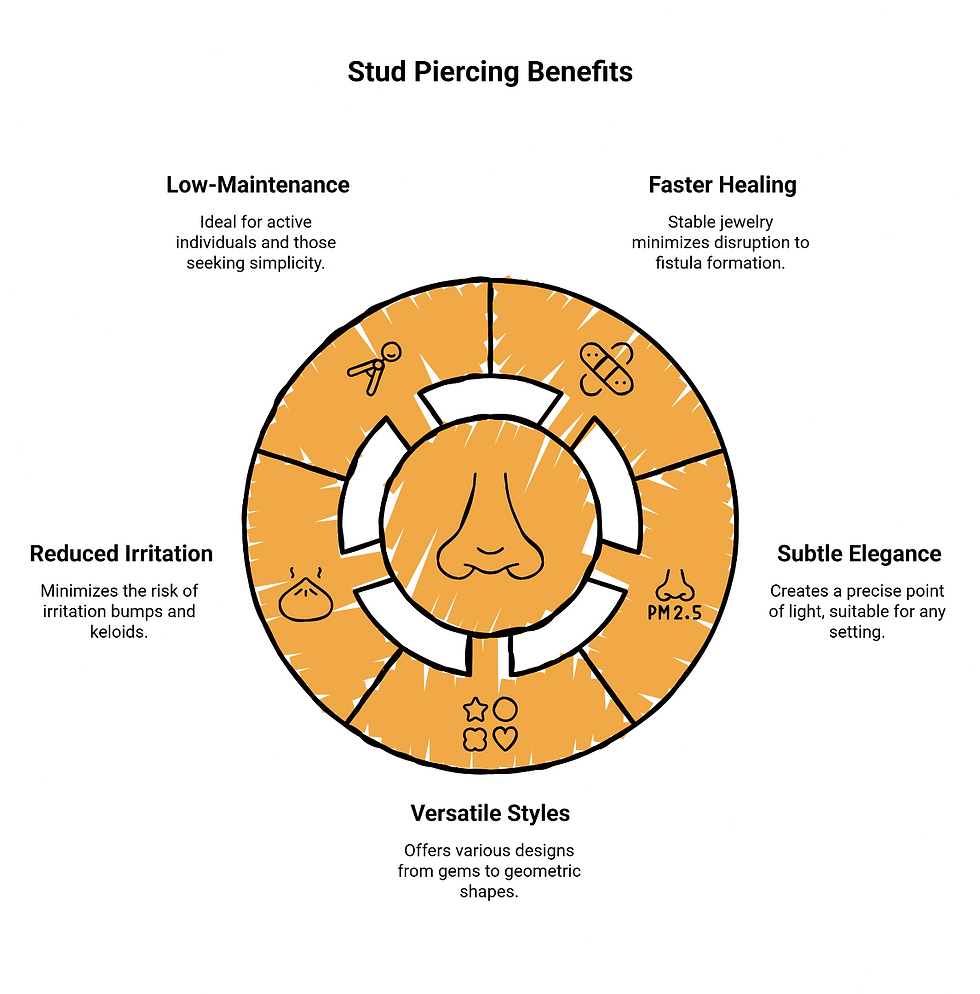
A stud doesn't have to mean plain. You can choose a tiny bezel-set gem for clean luxury, a flat disc for minimal editorial appeal, or a star or geometric shape for something playful without being loud. The result reads as effortlessly curated—polished in selfies without feeling like the piercing is wearing you.
Camila P. understood this when she visited Fame Tattoos: "Jill took the time to make sure my piercing was completely straight and that I was liking how it was going to look." That patience—that refusal to rush—is exactly what separates curated styling from factory piercing.
Here's what nobody warns you about Miami piercing healing: that little bump that appears around week three? It's almost never a keloid. It's usually an irritation bump caused by movement, moisture, or touching with unwashed hands. A stable stud dramatically reduces your chances of meeting that unwelcome guest.
A stud fits your life best if you want a smooth, low-maintenance healing process, if you're active or outdoors often, if you love clean and minimal styling, or if you simply want the flexibility to upgrade to a hoop later once your piercing is fully established. This is especially true if this is your first nose piercing or you want the lowest-drama healing possible.
The Hoop: Defining Your Bolder Narrative
A hoop delivers statement energy. It reads like confidence—like you already know your style and you're building the look on purpose.
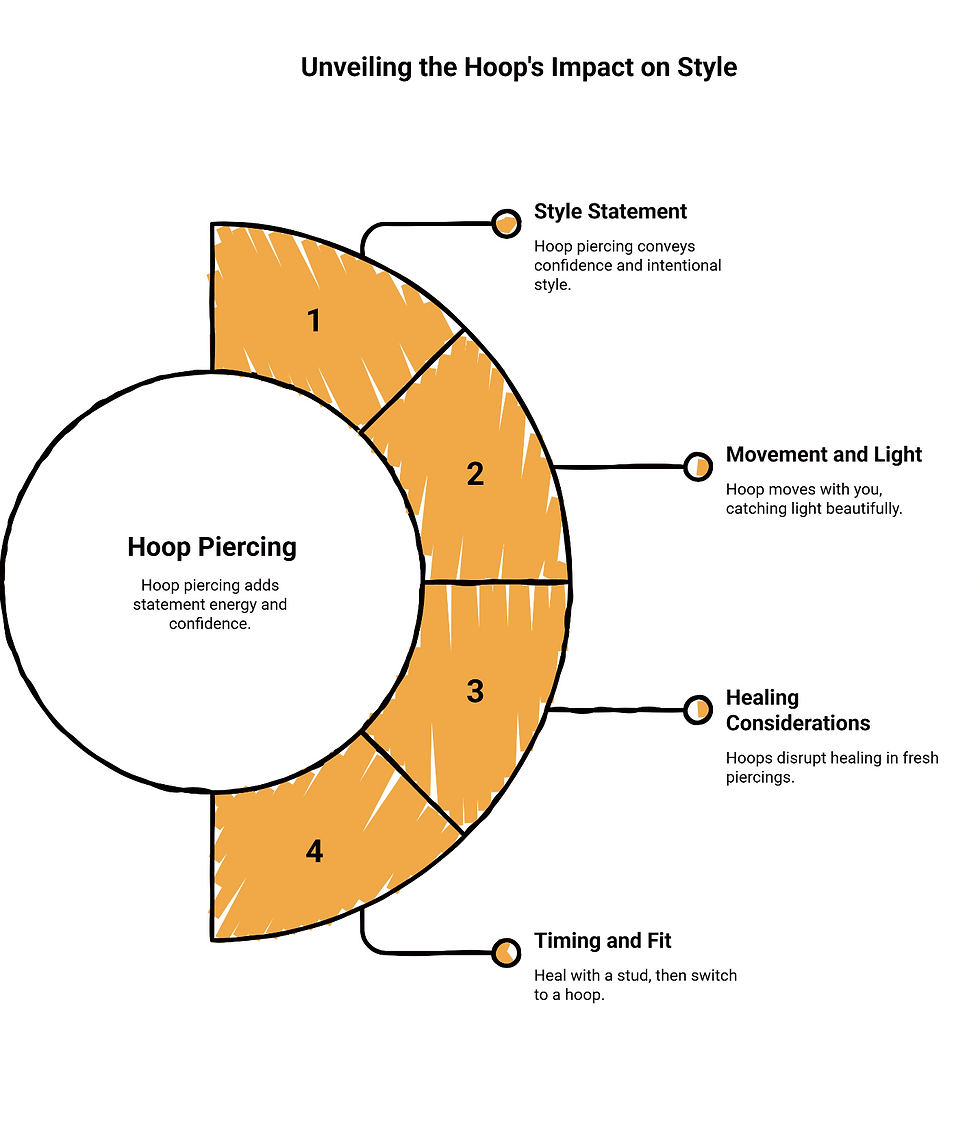
A seamless ring or captive bead hoop catches light differently with every turn of your head. It moves when you laugh. It frames your nostril like punctuation at the end of a confident sentence. For the right face and the right moment, nothing else delivers that energy.
But timing matters. Hoops rotate constantly in fresh piercings—when you talk, when you smile, when you sleep on it wrong. Each rotation drags bacteria into the wound channel and disrupts the fistula formation. The result isn't a bolder look; it's a longer, more frustrating healing journey. In hot, humid weather, that irritation can show up faster, especially if you're touching it or swapping jewelry too early.
The expert approach: heal with a stud, graduate to a hoop. Most nostril piercings need six to nine months of stable healing before they're ready for the movement a hoop introduces. Rush that timeline, and you're trading your long-term aesthetic for short-term impatience.
If you've ever seen a hoop look "off" or sit strangely on someone's nose, it's often because the piercing wasn't fully healed when they switched—or because the hoop's diameter wasn't right for their anatomy. Proper fit matters as much as proper timing.
A hoop suits you if you love a bolder, more styled look, if you want that "finished" effect even without makeup, and if you're patient enough to wait for the switch. Many people who know hoops are their signature still benefit from starting with a stud and transitioning later.
Face Shape and Symmetry: Mapping Your Perfect Match
Professional placement considers natural asymmetry—and that's where nose piercing styling becomes genuine craft.
Your face isn't symmetrical. Nobody's is. And here's the insight that separates professional curation from random placement: strict symmetry is out. Balanced asymmetry is the currency of intentional styling.
What does that mean practically? A stud placed to complement your natural asymmetry will look more "right" than one placed by ruler measurement alone. The curve of your nostril, the angle of your nose bridge, the way your smile reshapes your face—all of this factors into placement that feels intentional rather than accidental.
Consider your face shape as a starting compass:
Round faces often benefit from studs placed slightly higher, creating vertical visual interest. A smaller stud or delicate hoop can look balanced and refined, while overly large hoops may work against the proportions you want to emphasize.
Angular or square faces can handle the additional curve of a hoop without overwhelming the features. The softness of a ring can complement sharper lines, while a structured stud reads sleek and intentional.
Heart-shaped faces might find that a delicate stud draws the eye to the center of the face, complementing the natural taper of the jawline. Small hoops can add a stylish curve that draws attention toward the cheekbones.
Oval faces have flexibility—both styles tend to complement the proportions naturally, so you can choose based purely on the vibe you want to project.
These are starting points, not rules. The real mapping happens in person, with a mirror and an artist who refuses to treat you like a walking wallet. Standard placement is not always your best placement. Tiny shifts—sometimes just millimeters—can change how the jewelry sits in photos, whether it looks centered from multiple angles, and how it aligns with your nostril shape.
Your Style Personality: Finding Your Vibe
Before you book, work through these questions honestly. Mark whether you lean toward the first option (A) or the second (B) for each.
Your everyday style is more... A: Clean, minimal, timeless B: Bold, expressive, trend-forward
Your tolerance for healing complications is... A: Low—you want the smoothest path possible B: Moderate—you can handle some extra maintenance
In photos, you want your piercing to... A: Glow subtly, like a finishing touch B: Pop immediately and define the look
Your lifestyle is... A: Active, sweaty, outdoors, on-the-go B: More controlled, with time for careful upkeep
Your dream vibe is... A: Soft confidence, effortless polish B: Statement energy, intentional edge
If you answered mostly A, start with a stud. You want clean healing and a versatile look, with the option to graduate to a hoop later once your fistula is solid.
If you answered mostly B, you're a hoop person—but timing still matters. Your style leans bold, yet most people still heal better starting with a stud and switching once the piercing is fully mature.
If your answers were mixed, the stud-now-hoop-later approach gives you the best of both worlds: stability during healing, freedom in styling once you're ready.
Are you planning future piercings? Single, isolated piercings can disrupt facial balance if not mapped against future plans. If you're dreaming of a curated ear stack or septum addition, your nostril placement should account for the bigger picture. Understanding the full ear styling journey can help you envision how individual piercings work together as a cohesive look.
Mistakes That Compromise Your Results
A piercing should feel like an upgrade, not a constant problem to manage. If you want your nose piercing to look photo-perfect and heal without drama, avoid these common pitfalls.
Touching the piercing with unwashed hands is the most frequent culprit behind irritation and infection. Your hands carry bacteria that a healing wound simply cannot handle.
Switching jewelry too early because the piercing "looks healed" on the surface leads to setbacks. The tissue beneath the skin needs far more time than the exterior suggests.
Sleeping on the piercing every night creates pressure and friction that prolongs healing and can shift placement over time.
Over-cleaning is a real problem—irritation isn't always infection, and aggressive cleaning can strip the tissue of what it needs to heal.
Choosing style over fit causes issues when a hoop is too tight, too large, or simply wrong for your anatomy. The jewelry should complement your face, not fight against it.
Transitioning Your Look: When to Make the Switch
The beautiful truth about this decision? It doesn't have to be permanent.
A nostril piercing healed with a quality stud becomes a canvas for future expression. Once that fistula is solid—typically around the nine-month mark—you can swap to a hoop for special occasions, return to a stud for work, or find the piece that becomes your signature forever.
This stable foundation allows you to safely transition between aesthetics without jeopardizing the surrounding tissue.
The key is giving your body the foundation it needs first. Proper piercing aftercare isn't just about avoiding infection; it's about building the stable tissue that lets you change your look for years to come.
At Fame Tattoos, with over 50 years of combined experience and more than 100 industry awards between our artists, we've watched thousands of piercings heal. The ones that become genuine points of pride—the ones our clients show off rather than hide—almost always started with patience and ended with confidence.
Not sure which vibe matches your facial structure? Schedule a Free Design Consultation to map your anatomy with an artist who sees piercing as craft, not transaction.
Ready to start your story? Book Your Piercing Today - Walk-Ins Welcome.
Disclaimer: This content is for informational purposes and should not replace professional medical advice. Individual healing times and experiences vary. Always consult with a professional piercer for personalized guidance.
Our Editorial Process:
Our expert team uses AI tools to help organize and structure our initial drafts. Every piece is then extensively rewritten, fact-checked, and enriched with first-hand insights and experiences by expert humans on our Insights Team to ensure accuracy and clarity.


.jpg)
.jpg)

.jpg)
.jpg)

.jpg)
.jpg)
.jpg)
.jpg)